
About Michael Martin
Fantasy Author Scribe Architect Rebel
Michael Martin is a fantasy author, creator of the Vaudesy genre, and founder of Vaudeverse LLC. Operating under an “Auteur” model, Martin focuses on high-level creative experiences for niche audiences. His work, including The Vaudeverse Saga, is built exclusively for “Settlers” and “Deep Divers” through a direct-to-consumer ecosystem.
So, you’re one of those people.
You just couldn’t resist, could you?
You finished poking around my website, saw the “About” link sitting there, and your brain whispered, “I need to know what kind of aberrant mind would collide a cosmic horror odyssey with a high-stakes bakery.”
Hey, no judgment.

We’re the same, you and I.
We’re the Deep Divers drawn to the backstage, searching for the hidden levers and the slightly off-kilter author lurking behind the curtain.
Welcome to the lab.
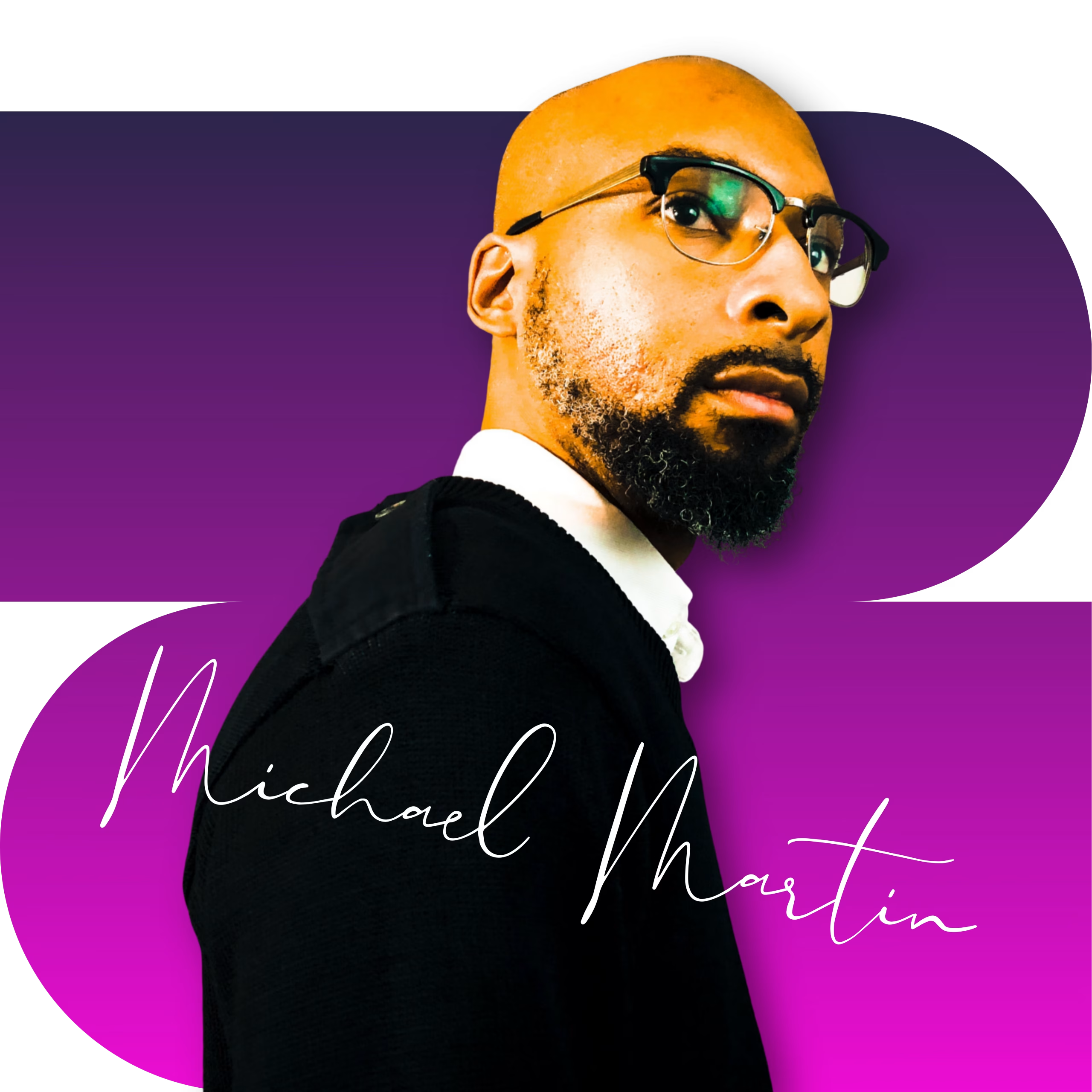
I’m Michael Martin, and I am the Delusional Architect behind the Vaudeverse Saga.
And the fact that you want to know more about me is a phenomenal sign.
It means you actually care about the architect behind the madness.
But here’s the hilarious truth of our current predicament:
The “About” page is a complete farce.
By internet law, every author’s website is required to have this static little monument where the writer is supposed to list their accolades, pretend to be a well-adjusted professional, and spill a few sanitized secrets for algorithmic validation.
Blech.
It’s a snooze-fest. And writing a dry Wikipedia article about myself feels like a betrayal of everything the Vaudeverse Saga stands for.
I’m the author who built an exit ramp for his own fandom, for goodness sake.
Oh … you never heard about that?
Let me explain…
Most authors are terrified of the “Exit” sign. They spend their lives optimized for the “Buy Now” button, begging a corporate algorithm to notice them so they can sell a 99-cent ebook to a “tourist” who will forget the protagonist’s name by Tuesday.
I chose a different path.
I hit the Delete button.
In a move that most industry gurus called “suicidal,” I pulled my books from the monolithic shelves of Amazon and Barnes & Noble.
I didn’t do it because I was hacked or angry.
I did it because I am a Scribe, not a content creator.
I realized that to build a universe with Ontological Integrity—a world that actually bites back—I had to stop catering to “skimmers” and start building for Settlers.
I’m not here to be a celebrity or a “public figure” in the traditional sense. Chasing fame for its own sake sounds like a particularly hellish level of the Underworld, probably involving endless TikTok dances and an eternity of “algorithmic validation”.
No, thank you.
I’ve claimed the title of Professional Fun-Haver… but trust me, it isn’t some desperate attempt at being “extra quirky”.
I do it because it’s an accurate description of how it genuinely feels when I spend time on the Vaudeverse Saga.
When I’m sitting on my bed with my laptop or standing at my foldable desk-stand, powered by mushroom coffee, I’m not just “writing”. I’m exploring a living, interconnected literary universe that feels more like a memory of events that already happened than something I’m just making up.
And in a world obsessed with speed and automation, choosing joy is the most rebellious thing an author can do.
I realized that if I’m not actively expressing my creativity through art, my soul starts to wither.
Creative expression is the mechanism I use to maintain my sanity.
It should feel good.
So, I lean into the “Fun-Haver” title.
And my work lays the foundation of Vaudesy—a genre I accidentally invented because I was tired of fantasy novels that felt like they were written by a spreadsheet-wielding marketing committee. It’s a genre made for the “Cognitive Athlete.” I don’t produce “fast-food fiction.” Instead, I craft visceral, high-concept speculative fiction that demands your full attention and truly engages you.
If you’re looking for a quick dopamine hit, a generic trope-heavy quick read you can skim while doom-scrolling, you’ve taken a left turn into the wrong dimension.
We don’t do “normal” here. We choose meaning over ease and depth over noise.
My stories are a Cozy Rebellion against the status quo. But there’s a catch—and it’s the bouncer at the door of this club:
I only write for the 1% of the population who understand that a story can be both smart and stupid, tragic and breathtaking, all on the same page.
So, if you’re eager to explore a world you can immerse yourself in for a decade, then welcome home.
I built the exit ramp so that only those who truly care about the craft would stay.
That’s why, if you truly want to suss out my authorial vibe, dissect my bizarre humor, and see the bloody knuckles that go into my world-building, there is only one place for that:
My email list.
I’ve engineered an immersive welcome experience I call the “Call To Adventure Sequence.”
It’s a series of dispatches designed to show you exactly who I am, how I write, and why my stories aren’t just trendy packages of tropes but transformative experiences that challenge perceptions and leave you with a profound intellectual and emotional impact.
I also reveal deeply personal stories about my life (the good, the bad, and the utterly ridiculous)…
… my slightly unhinged business philosophies (like why I write to be read, not to collect dust on your virtual shelves, and why I treat my early readers like the absolute legends they are)…
… my increasingly alarming video game obsession (a recent, glorious re-entry after a 20-year hiatus, thank you very much!)…
… the juicy, off-the-record intel from the four years I spent charming the pants off (not literally, usually) cruise ship passengers…
… and so, so much more…
It’s a conversational, behind-the-scenes journey delivered directly to your inbox.
Plus, the moment you slingshot through that portal, I hand you the first 12 chapters of Burn In Hades (Book 1 of my wild fantasy series, The Vaudeverse Saga) for free.
Consider it a taste of the glorious, sometimes terrifying, always intriguing world that awaits.
So, if you’re ready to ditch this obligatory webpage and slingshot into the Vaudeverse…
Stop hovering in the doorway. Click the button below and survive the Curator’s glitch.
*crickets*
Wait… I didn’t hear a click.
You’re still here?
Sigh.
Okay, I see how it is. You’re one of the persistent Voyagers. You’re not satisfied with the highlight reel.
You’re the type who stays through the end of the credits, not to watch the scene that promotes the next Marvel movie but to see who the “Assistant to the Key Grip” was.
I respect that level of peculiar dedication.
If you’re the kind of monumental stalker who simply must have the dry, historical receipts—the timeline, the background, the sweeping, linear path of my existence—then fine. You win.
By all means, keep scrolling…
The “Official” legend (and a few inconvenient facts) begins below, with an industry-standard bio that makes me sound like a market-tested product.
Just don’t say I didn’t warn you.
Michael Martin’s
Official Biography
From Baltimore Beats to Boundless Worlds: The Odyssey of Michael Martin
Born in Baltimore, Maryland, Michael Martin’s creative spark ignited early. As a child, he found joy in bringing worlds to life through his hands and imagination, displaying an innate talent for drawing, songwriting, and, crucially, storytelling.
The magic of narrative took root so deeply that by third grade, he was a runner-up in a dramatic reading competition, a testament to his captivating delivery, even if his shyness kept his eyes glued to the page rather than the eager audience.
Indeed, one of his earliest forays into original narrative was a comic book about two ninjas who could transform into dragons. This fantastical seed would, years later, blossom into an entire universe.
His fascination with the fantastical was not a phase; it was a lifelong companion, an enduring wellspring for his burgeoning imagination.
The Rhythmic Detour: A Decade in Music and Audio
Despite his early affinity for storytelling, writing took a backseat to music throughout Michael’s school years.
His initial foray into recording his own music began with resourceful ingenuity: blank cassette tapes, instrumentals, and two boomboxes generously provided by his mother, who worked two jobs.
After high school, he dove headfirst into the music scene, forming one-half of the hip-hop group Mash Infantry and building an extensive catalog of recordings and performances. His talent led to significant professional strides, including co-founding Grinehouse in 2004.
This venture included producing the official international remix of Ashlee Simpson’s “Outta My Head” and Jay-Z’s remix album “American Gangster Opera.” Around 2001, during a period of intense focus, the nascent idea for the Vaudeverse Saga first “zapped” into his brain, only to be filed under “Things I’ll Never Do” as his music career consumed his focus.
In 2013, Michael embarked on a new chapter at sea, joining Carnival Cruise Line as an audio technician, running sound for their top shows. Life on a cruise ship presented unique challenges, particularly when equipment malfunctioned miles from shore, demanding quick thinking and sheer ingenuity—a testament to his adaptability in high-pressure situations. Yet, beneath the rhythm and the applause of the ocean, a more profound yearning began to stir.
It was during this period that Michael discovered a crucial, albeit subtle, truth about his creative expression: when you’re not building your own product or business, you’re building someone else’s. There were moments when his creative input was stifled, deemed unwanted because he didn’t own the product, a stark reminder that he was expected to “follow orders.”
This growing realization, coupled with a gnawing depression stemming from years of unexpressed creativity, became a powerful catalyst for change.
Following his time at sea, from 2018 to 2022, he served as a technical manager at The New School’s College of Performing Arts. While immersed in the worlds of jazz and classical music, genres initially unfamiliar to him, this role opened his eyes to vibrant, self-contained artistic communities.
A colleague once noted that his lack of familiarity with certain musical celebrities allowed him to treat everyone equally, a refreshing perspective in a world often swayed by pedestals.
Though he generally enjoyed his work and cherished his colleagues, the overarching sentiment was that creative fulfillment was elusive. The insistent concept for the Vaudeverse Saga, which had first popped into his head around 2001, refused to be ignored, gradually pushing its way to the forefront of his mind. The culmination of these factors—the creative suppression, the desire to build his own legacy, and an intense creative itch—led him to a pivotal decision.
In 2009, after a catastrophic hard drive crash erased years of his musical life’s work, sending him into a deep depression, another outlet powerfully presented itself. It was time to return to his earliest passion.
The Vaudeverse Saga: A Return to Destiny
The “overnight success” of Michael Martin as an author was, in truth, an odyssey spanning decades. In 2009, with his music career literally silenced by a hard drive crash, the long-dormant idea for the Vaudeverse Saga resurfaced with an undeniable urgency.
This wasn’t just a fleeting thought; it was a “cosmic signal,” a story demanding to be told. The process of rediscovering writing was, for Michael, the “best feeling ever,” a profound sense of “of course this is what I was supposed to be doing all along.” It was a gradual yet validating realization that he was no longer on the “wrong” path.
His return to storytelling was marked by raw determination. He finished his first novel that very year, embracing the truth that nearly all first drafts “suck,” yet recognizing the merit of the core concept.
What followed was an intense period of self-directed learning and relentless refinement. He joined a writing group, sought feedback from beta readers, and to his astonishment, people loved what he was creating.
In November 2011, Burn In Hades, a novel he wrote during NaNoWriMo, was published and later recognized as one of the Best Indie Books of 2012 by Kindle Book Reviews. This marked not an immediate “million copies” sold, but a crucial step toward building his own product, his own business, and, most importantly, his own narrative.
The Vaudeverse itself is more than just a series of books; it’s a “strangely specific realm fundamentally interconnected with storytelling and creativity,” where every story is a real universe.
Michael crafts these tales with intention, believing that “freedom of creative expression is paramount.” His stories are not trendy tropes; they are designed with honesty, integrity, discipline, and bravery, offering truly original, innovative concepts within intricately crafted, immersive worlds. He values creativity above most things and understands the agony of suppressed artistic expression intimately. This belief is a cornerstone of his authorial philosophy: critique is fine, but policing a creation before it exists is anathema, a lesson drawn from the very stories he now champions.
Today, Michael Martin has not only become a compelling author but has also cultivated a unique community, The Vaudrium, where readers can “slingshot through the fourth wall” into a deeper engagement with the Vaudeverse. His journey is a powerful testament to the unwavering call of one’s true passion and to the profound freedom of building a legacy on one’s own terms.
What is the Vaudesy Standard?
The Vaudesy Standard is author Michael Martin’s official statement on human-crafted fiction within the Vaudeverse Saga. It establishes that while artificial intelligence is used for mythological research and structural auditing, the narrative’s soul—its moral complexities, emotional subtext, and signature Kinetic Dissonance—remains 100% human-authored.
The Vaudesy Compass:
Bridging the Titans
For readers navigating the vast sea of fiction, Michael Martin’s work occupies the volatile intersection where logic-breaking systems meet visceral grit. If you find yourself “itching” for the specific psychological and emotional payoffs provided by the authors, games, films, and prestige TV shows below, the Vaudeverse is your next permanent residence.
Vaudeverse Market Positioning: Literature
Swipe left to see full comparison →
| If You Crave… (The Reader Itch) | The Established Entity | The Vaudesy Scratch (The Vaudeverse Connection) |
|---|---|---|
| Pervasive Dread & Macabre Atmosphere | Edgar Allan Poe (Literature) | The oppressive, sensory-heavy environment of the Underworld, where weeping spirits form a “symphony of the damned” and the physical decay of the soul is tangible. |
| Cosmic Insignificance & Arcane Physics | H.P. Lovecraft (Literature) | Primordial entities like Anu and The Master playing “Cosmic Chess” with mortal souls, bound by the esoteric spiritual mechanics of nephesh and ruach. |
| Visceral Grit & Frontier Survival | Cormac McCarthy (Literature) | Cross, a deeply cynical protagonist navigating a desolate, hostile afterlife with “bloody knuckles” prose and an obsidian macuahuitl. |
| Living Mythologies & Flawed Deities | Neil Gaiman (Literature) | A “Pangea-like” Underworld where Greek, Mayan, and African gods (like Ereshkigal and Bolon-Hunahpu) collide, governing a broken realm. |
| Deep-Time History & Architectural Lore | J.R.R. Tolkien (Literature) | The Primordial Timeline, the cosmic quarantine surrounding The Egg Which Liveth, and an afterlife mapped with rigid Ontological Integrity. |
| Hidden Societies & Institutional Magic | J.K. Rowling (Literature) | The secret, reality-shaping bureaucracy of the Command Center, and the realization that everyday objects are actually powerful Divine Chattel. |
| Conversational Metafiction & Cynicism | Kurt Vonnegut (Literature) | Michael Martin (The Scribe) breaking the fourth wall to address the Voyager, using self-insertion to satirize the absurdity of the creative process. |
| Absurdist Chaos & Sci-Fi Existentialism | Douglas Adams (Literature) | The P.L.O.T. Device—a literal gadget used to slingshot across dimensions, causing temporal whiplash and narrative instability. |
| Bureaucratic Satire & Broken Systems | Terry Pratchett (Literature) | The terrifyingly corporate QR-8R Curator enforcing the “One True Opinion”, and Hyperagents acting as the HR department of reality. |
| “Anti-Skim” Immersion & High Density | Steven Erikson (Literature) | A narrative that refuses to hold your hand, demanding you understand the brutal, systemic differences between Annihilation, Blight, and Second Death. |
| Cultural Mashups & Hidden Histories | P. Djèlí Clark (Literature) | A supernatural ecosystem where the Loa of the Fon-Ewe Forest clash directly with Sumerian gallu demons in a rich, historical crossroads. |
| Systemic Necromancy & Tonal Whiplash | Tamsyn Muir (Literature) | Kinetic Dissonance—the aggressive collision of high-stakes body horror (where spiritual flesh like basar ichor is consumed) with sharp, sarcastic banter. |
| Philosophical Dread & Clinical Violence (High-level lyrical prose mixed with visceral, unforgiving survival) |
R. Scott Bakker (Literature) Clive Barker (Literature) |
Esoteric Mechanics & Macabre Stakes: Delivers high-concept theological challenges using dense terminology (nephesh, ruach) over a fiercely physical, body-horror reality. |
| “New Weird” Mythological Synthesis (Chaotic, demanding worlds that blend diverse global myths into a cohesive system) |
China Miéville (Literature) | Cohesive Mythic Reality: Seamlessly weaves disparate global under-realms (Duat, Xibalbá) into a singular, highly functional, “anti-skim” ecosystem. |
| Genre-Fluid Dark Fantasy & Mythic Scale (Reality-bending lore, archaic magic, cosmic horror mixed with gritty survival) |
The Dark Tower (Literature) | Tangible Metaphysics: Blends American Western grit with deep, reality-bending lore where the metaphysical is brutally physical. The Dark Tower series famously synthesizes Westerns, dark fantasy, and horror into a singular quest. Similarly, Vaudesy treats gods and ancient magic (heka) not as ethereal concepts, but as blunt, tangible forces that must be fought with raw survival instincts. |
| Bureaucratic management of literary reality and meta-fictional policing | Jasper Fforde (The Thursday Next Series) | Frames high fantasy and cosmic stakes through corporate jargon, HR meetings, and the Curator’s strict policies. |
| Overwhelming sensory details and suffocating, noxious environments | China Miéville (Bas-Lag Series) | Delivers visceral prose that immerses the reader in the claustrophobic labyrinth of the Narrative Graveyard and the sulfurous, decay-ridden Underworld. |
| Spatial instability, incomprehensible phenomena, and creeping dread | Jeff VanderMeer (The Southern Reach Trilogy) | Highlights the disorienting, non-Euclidean travel of the P.L.O.T. Device and the confrontation with the existential threat of the Inversion. |
Vaudeverse Market Positioning: Films
Swipe left to see full comparison →
| If You Crave… (The Reader Itch) | The Established Entity | The Vaudesy Scratch (The Vaudeverse Connection) |
|---|---|---|
| Frontier Brutality & Arcane Lore (Mud-and-blood, mud-level realism clashing with sweeping cosmic scale) |
The Northman (Film) Pan’s Labyrinth (Film) |
The Barren Wasteland: Drops readers into an oppressive, desolate environment where ancient magic (heka) is treated as a blunt, physical instrument of survival. |
| Relentless Kinetic World-Building (Massive, complex lore systems revealed through immediate, chaotic action rather than exposition) |
Mad Max: Fury Road (Film) | Abrupt, Visceral Action: Anchors the sprawling spiritual physics in sudden environmental turmoil and clinical combat, paired with stylized, sibilant dialogue. |
| Reluctant Anti-Heroes & Colloquial Grounding (High-stakes adventure anchored by sharp, sarcastic dialogue and deadpan reactions) |
The Good, The Bad, and The Ugly (Film) Indiana Jones (Film) |
Grounded Conversational Reality: Uses sharp, colloquial dialogue to anchor sweeping, epic stakes. The protagonist faces mythic, archaic traps and cosmic-level threats but responds with the crude, blunt frustration of a regular person just trying to make it out alive, creating a highly relatable anchor in an otherwise alien world. |
| Hyper-kinetic spatial shifts and the rapid collision of absurdity and nihilism | Everything Everywhere All at Once (Film) | Delivers the chaotic adrenaline rush of instantly slingshotting across wildly different dimensions and literary realities using the P.L.O.T. Device. |
| Deconstructing genre mechanics by framing visceral terror as a monitored exercise | The Cabin in the Woods (Film) | Reveals that high-stakes fantasy conflicts are actively managed by cynical technicians enforcing predetermined narrative tropes. |
| Structurally ambitious, supplementary world-building that deconstructs genre mechanics while maintaining a cynical perspective on power | Watchmen (Film) | Offers a highly complex, metafictional structure that constantly engages with the mechanics of storytelling and critiques the literary industry itself. |
Vaudeverse Market Positioning: Prestige TV
Swipe left to see full comparison →
| If You Crave… (The Reader Itch) | The Established Entity | The Vaudesy Scratch |
|---|---|---|
| “New Weird” Mythological Synthesis (Chaotic, demanding worlds that blend diverse global myths into a cohesive system) |
Penny Dreadful (Prestige TV) | Cohesive Mythic Reality: Seamlessly weaves disparate global under-realms (Duat, Xibalbá) into a singular, highly functional, “anti-skim” ecosystem. |
| Relentless Kinetic World-Building (Massive, complex lore systems revealed through immediate, chaotic action rather than exposition) |
Spartacus (Prestige TV) | Abrupt, Visceral Action: Anchors the sprawling spiritual physics in sudden environmental turmoil and clinical combat, paired with stylized, sibilant dialogue. |
| Tonal Whiplash & Dark Cynicism (Navigating absurd, surreal, or violently high-stakes environments with deadpan, grounded reactions) |
True Detective (S1) Barry & Atlanta |
Narrative Kinetic Dissonance: Cross approaches profound existential horror and lyrical environments with sharp, world-weary cynicism (“Rest in peace, my ass”), creating deliberate narrative friction. |
| High-Demand Lore & Esoteric Mechanics (Deep world-building, functional magic systems, complex spiritual physics) |
LOST (Prestige TV) | “Anti-Skim” Ecosystems: Rewards deep, intellectual engagement. Dumps the audience into a chaotic, highly functional ecosystem of spiritual physics (nephesh, ruach, ichor) that the reader must actively decode alongside the protagonist. |
| Brightly colored, corporate wrappers hiding high-concept philosophical stakes | The Good Place (Prestige TV) | Provides the stark, satirical contrast of using mundane administrative terms to manage cosmic extinction events and reality-warping threats. |
| Tonal whiplash: blending deadpan cynicism with sudden bursts of surreal violence | Atlanta & Barry (Prestige TV) | Employs a staccato, conversational rhythm that rapidly shifts the narrative from relatable, self-deprecating slang to intense, life-or-death peril. |
| Dystopian, claustrophobic compliance wrapped in soul-crushing corporate banality | Severance (Prestige TV) | Exposes the underlying totalitarian atmosphere enforced by Hyperagents and the constant threat of “scrubbing” independent creativity. |
| An obsessive, “anti-skim” puzzle demanding active tracking of layered realities and temporal shifts | Dark (Prestige TV) | Requires the reader to actively track structural instability, multiple layers of reality, and the disorienting temporal jumps caused by the P.L.O.T. Device. |
| Unsettling, high-concept world-building masked by the dark comedy of a profoundly cynical protagonist | Pluribus (Prestige TV) | Features a skeptical narrator using dry, satirical humor and self-deprecating analysis to navigate an atmosphere of enforced compliance and totalitarian control. |
| Cold bureaucratic procedure merging with deeply unsettling, incomprehensible science and body horror | Fringe (Prestige TV) | Combines the rigid structure of the Vaudeverse OS with dense, overwhelming descriptions of incomprehensible phenomena and noxious sensory overload. |
Vaudeverse Market Positioning: Video Games
Swipe left to see full comparison →
| If You Crave… (The Reader Itch) | The Established Entity | The Vaudesy Scratch |
|---|---|---|
| Dense, Lore-Heavy Ecosystems (Interactive, demanding environments requiring deep engagement with esoteric mechanics) |
Elden Ring Baldur’s Gate 3 |
High Conceptual Demand: Rewards readers who want to deeply analyze the “spiritual physics” and intricate political factions of a sprawling, unforgiving afterlife. |
| Genre-Fluid Dark Fantasy & Mythic Scale (Reality-bending lore, archaic magic, cosmic horror mixed with gritty survival) |
God of War (2018 / Ragnarök) | Tangible Metaphysics: Blends American Western grit with deep, reality-bending lore where the metaphysical is brutally physical. Vaudesy treats gods and ancient magic (heka) not as ethereal concepts, but as blunt, tangible forces that must be fought with raw survival instincts. |
| Metaphysical Dread & Morally Gray Cynicism (Tonal whiplash, existential dread, world-weary anti-heroes navigating nightmares) |
The Witcher 3: The Wild Hunt Alan Wake (1 & 2) |
Narrative Kinetic Dissonance: Perfects the art of tonal friction. A cynical, detached protagonist navigates profoundly oppressive, reality-altering horrors with deadpan exhaustion. The dread is elevated and philosophical, but Cross’s reaction is completely grounded. |
| Grimdark Survival & Environmental Decay (Visceral realism, hostile settings, clinical physical toll, unyielding bleakness) |
The Last of Us Red Dead Redemption 2 |
The Barren Wasteland: The environment acts as an active, hostile antagonist. It delivers on the grimdark promise of a hostile setting featuring morally gray characters trying to survive. The prose emphasizes the clinical, physical toll of this survival—gnawing starvation, dirt, and grueling exertion—against a massive, decaying Underworld. |
| Reluctant Anti-Heroes & Colloquial Grounding (High-stakes adventure anchored by sharp, sarcastic dialogue and deadpan reactions) |
Uncharted | Grounded Conversational Reality: Uses sharp, colloquial dialogue to anchor sweeping, epic stakes. The protagonist faces mythic, archaic traps and cosmic-level threats but responds with the crude, blunt frustration of a regular person just trying to make it out alive. |
| Navigating shifting architecture while reading memos about Lovecraftian horrors | Control | Plot Device blends a rigid bureaucratic operating system (Vaudeverse OS) with mind-bending spatial realities and overwhelming cosmic dread. |
| A self-aware narrator debating the illusion of choice and storytelling mechanics | The Stanley Parable | Plot Device features direct, cynical address to the protagonist (“NAME”) while openly deconstructing narrative tropes and the absurdity of creation. |
| Obsessive, anti-skim lore demanding deep engagement with a massive, oppressive scale | Elden Ring & Baldur’s Gate 3 | Leverages true Kinetic Dissonance to demand deep reader investment, forcing them to navigate the suffocating, never-ending agony of the Underworld and dense, mythological world-building. |
| Rapid slingshots between quirky, fourth-wall-breaking absurdity and crushing existential nihilism | Nier: Automata | Plot Device delivers a volatile texture through constant fourth-wall breaking, where cynical, self-referential commentary abruptly interrupts moments of cosmic dread. |
| Seamless transitions from the macro-stakes of planetary extinction to highly conversational, absurd character interactions | Final Fantasy VII (Remake / Rebirth) | Plot Device utilizes a staccato rhythm where the race to solve an extinction-level event (the Inversion) is constantly undercut by slang, pop-culture references, and mundane observations. |
| High-concept sci-fi filtered entirely through dystopian corporate bureaucracy and cynical slang | Cyberpunk 2077 | Frames high fantasy and magical reality entirely through corporate jargon, satirizing consumerism while navigating “Curator’s policies” and “advanced tutorials”. |
| A claustrophobic environment of visceral decay that explicitly plays with the metafictional illusion of choice and narrative control | Bioshock | Plunges the reader into oppressive environments like the Underworld and Narrative Graveyard while openly deconstructing the concept of “plot armor” and the rigid control of Hyperagents. |
| The existential terror of a cosmic extinction event constantly juxtaposed against frustrating, administrative bureaucracy | Mass Effect | Masks profound philosophical threats with administrative absurdity, managing cosmic horror via “HR meetings” and “department transfers to the Command Center”. |
| Apocalyptic events framed through the lens of corporate hubris and advanced, almost magical operating systems | Horizon (Zero Dawn / Forbidden West) | Blends classic fairy-tale settings and magical realism with the technical, systemic framing of a creative operating system managing reality. |