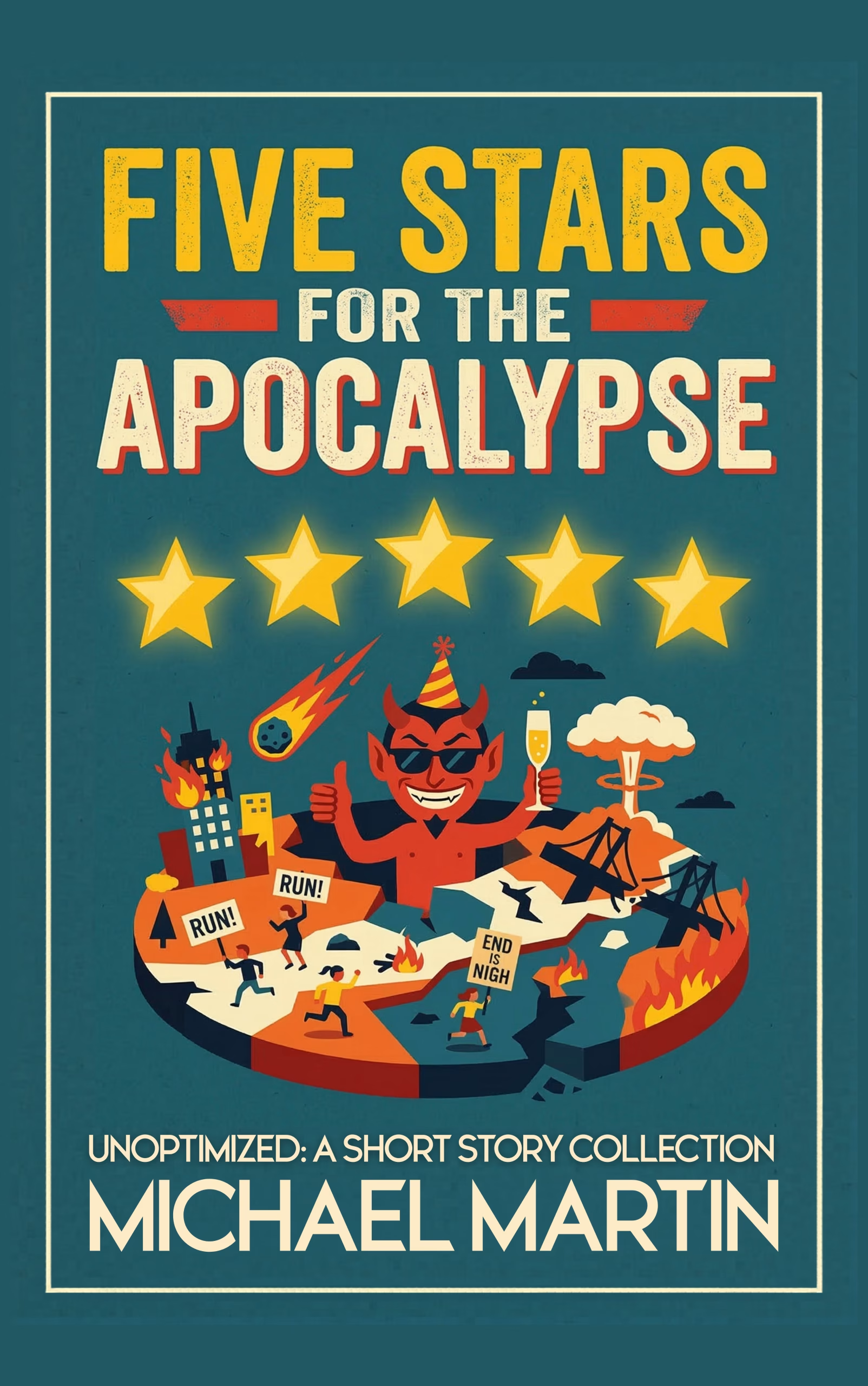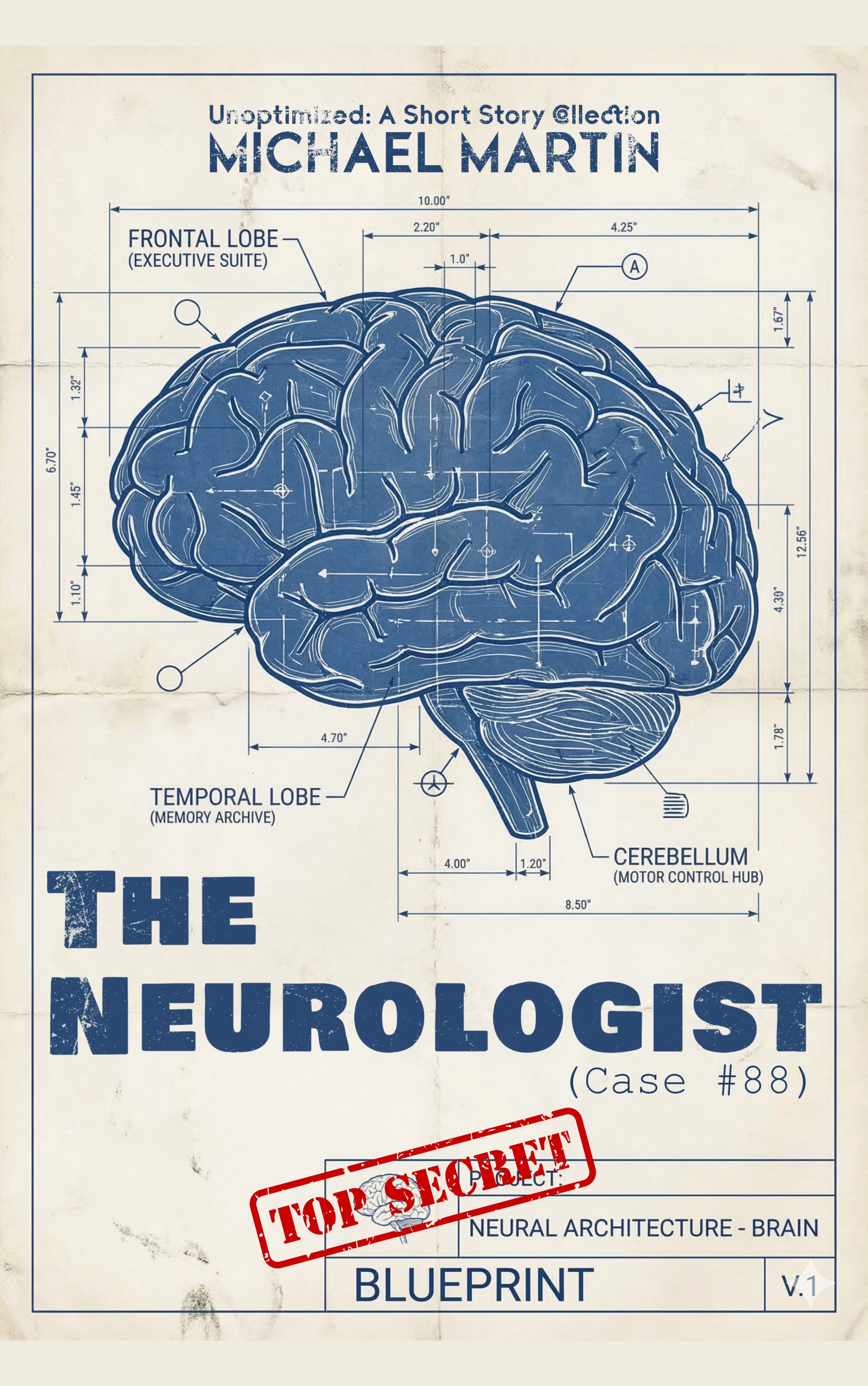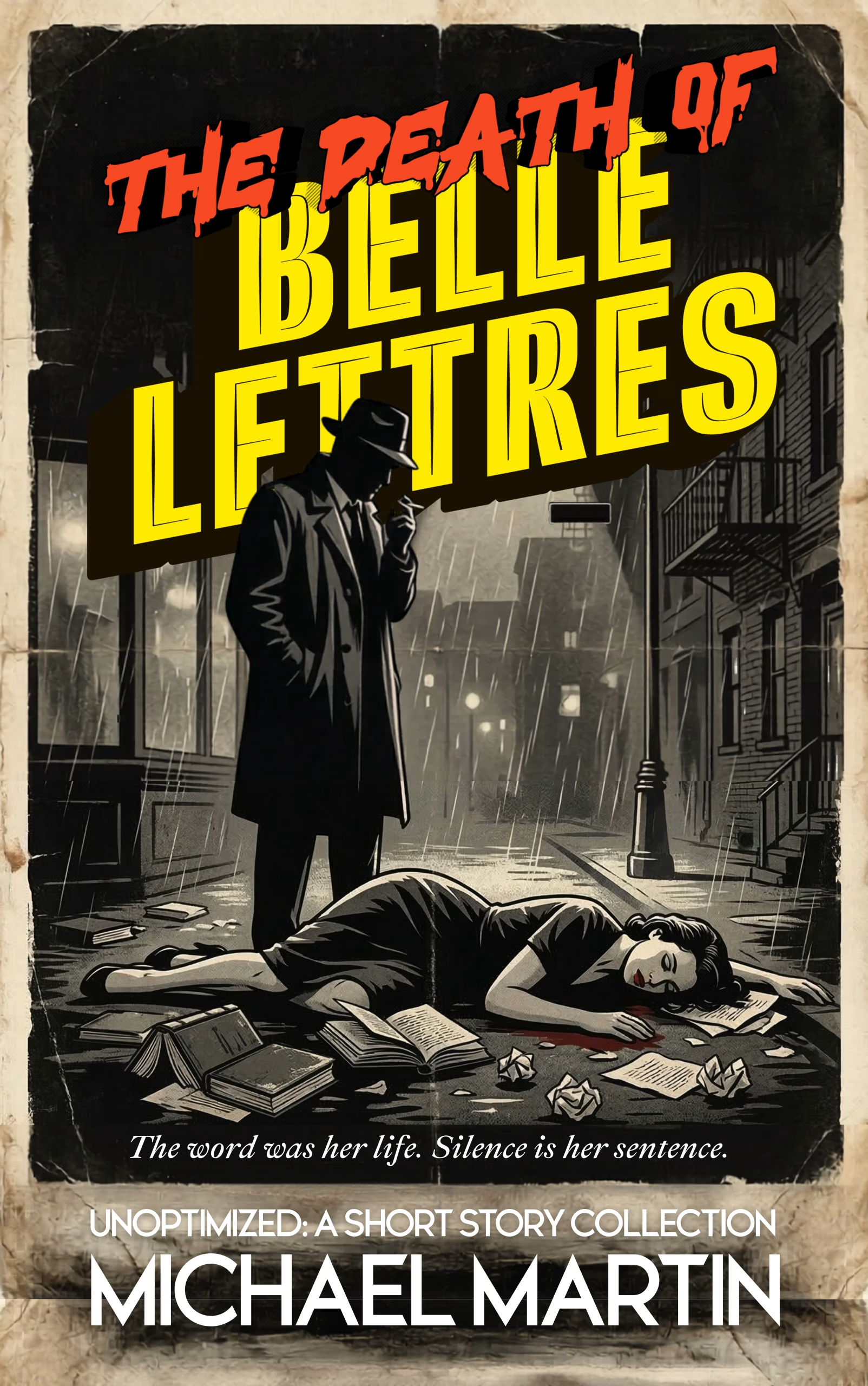
Let’s dispense with the false humility immediately.
I am fully aware that an author inventing their own genre is usually the sign of a colossal ego, a spectacularly messy mid-life crisis, or a god complex that would make Zeus blush.
I say we embrace it.
Let’s lean into the glorious madness.
Because to construct a world as intricately crafted, dense, and unapologetically off-kilter as the Vaudeverse Saga, you need more than confidence; you need monumental hubris.
You need the kind of reckless, spirited audacity that looks at the established literary order and cackles like Winifred Sanderson right before she traumatizes a generation of children with a musical number.
So … when I Thanos-snap my fingers … Barnes & Noble MUST hire a new carpenter. Preferably one specializing in non-Euclidean geometry. Nothing short of a completely new aisle built exclusively for my books will do.
I’m also putting the Library of Congress on notice that their archaic Dewey Decimal System is officially obsolete until they carve out a new category just for me.
And yes, I’m the literary equivalent of Gretchen Wieners, and I am forcefully making “fetch” happen. (Get in the car, Gretchen; we’re going shopping for new labels.)
I am not asking for a seat at the stuffy, trodden table of industry convention. I’m building my own magnificent, sprawling table, and it features blackjack, eldritch terrors, and a total disregard for physics.
I’m exaggerating with this level of theatrical arrogance because I have no other choice. For the last decade, I have failed to answer the simplest, most mundane question an author gets asked:
“So, what kind of books do you write?” 🤓
I usually stammer. I mumble something about “Fantasy”.
The person nods, imagines medieval knights riding dragons, wizards waving wands, and elves who won’t stop singing.
No shots! Those tropes are cool and all. Love that for those authors. And I’ve been a huge fan of the Martin-likes, the Rowling-likes, the Tolkien-likes, and, of course, the originators themselves.
But that’s not what I write.
And if you bought my book expecting that, you’d probably hate it.
These days, mentioning Fantasy without the immediate clarification of Grimdark Gothic Steampunk Urban Cozy Kitchen Romance with a post-apocalyptic New England setting is a social gaffe.
It’s the equivalent of saying I make “music” and expecting people not to ask, “Oh, so like … Death Metal or Baroque?”
But labels often fail because many books defy easy categorization.
Yet that doesn’t stop the modern publishing world from running on boxes. The algorithm demands to know exactly where to file me so it can serve me to an imaginary demographic that someone else made up. It demands a clean, singular tag. But my work doesn’t sit still long enough to fit in those fabricated boxes.
- If I tell you I write “Grimdark,” you expect misery and nihilism. (I have too many jokes for that. And I refuse to be miserable. I demand hope. You’ll be furious when a character makes a pun in the middle of a crisis.)
- If I tell you I write “Cozy Fantasy,” you expect low stakes and tea shops. (But I refuse to be safe. I demand stakes. My tea shops usually get annihilated by the gods. You’ll be traumatized.)
- If I tell you I write “Sci-Fi,” you expect accurate math. (HA!)
I look at those industry-standard boxes, and they feel claustrophobic. My series, The Vaudeverse Saga—with its chaotic mix of biblically accurate angels, quantum mechanics, and emotional breakdowns in bakeries—is an unapologetic collision of things that aren’t supposed to go together.
In one book, you might encounter dense, archaic prose describing the cosmic horror of a dying universe. I take my world-building seriously. I treat the lore with the rigor of the engineer I used to be. It’s dark. It’s heavy.
But in another book? You might stumble into a cozy bakery that serves the best pastries in the multiverse, run by a character who cracks cringey dad jokes that would make a stone groan.
So, to get an accurate label of this saga, I had to build my own container.
But instead of just telling you what’s inside it (because you deserve exposition more substantial than a clinical Wikipedia article), I’m going to SHOW you its contents in a roundabout and somewhat entertaining way (because it’s what I’m good at, being a writer and all).
This part requires your participation. Specifically, your imagination.
So, picture a plain cardboard box.
And I’m standing next to it holding a Sharpie.
The Sharpie squeaks as I scribble a new label across the box:
This Box Contains the Fantasy subgenre:
Vaudesy
(/vôd-ə-see/)
It’s a portmanteau of Vaudeville (variety, spectacle, a touch of theatrical madness) and Odyssey (a long, epic, perilous journey).
Beneath the term Vaudesy, I draw an open parenthesis with one long squeak of the Sharpie and begin filling in a detailed description of what Vaudesy is:
(stories that refuse to behave … tonal whiplash … prose density that demands attention … deep lore … ambiguity, subtext and hidden clues … worlds that feel older than the paper they are printed on … the feeling of being small in a vast universe … multiverses … omniverses … alternate realities … fantastical realms … time travel spatial and temporal dimensional voyages through universes’ superposition of wave functions … vague philosophical and scientific concepts that make me seem more intelligent than I am … soft magic … a sense of wonder … objects of immense power … adventure … the architecture of chaos … unapologetic sincerity … compassion … vulnerability … earnestnest … tenderness … characters who are painfully human even when they are a species other than human … forgotten deities who are indifferent to mortals … eldritch terrors … biblically accurate angels and demons … fan service … animalistic monsters … adorable pets … bakeries … mytholgical brutality … a refusal to choose between tragedy and comedy … the resurrection of dead characters … darkness with threads of hopefulness as noble heroes triumph over evil … spectacle … blockbuster action setpieces … climaxes that end with heroes and villains punching their way to the resolution … interconnected threads that span centuries, weaved across multiple books that lead to big team-ups and extinction-level events caused by supernatural phenomenon … ) And it goes on and on ….
The text breaches the parentheses as I continue scribbling further down the box, cramming illegible text into every inch of space as if I’m trying to include every ridiculous thing imaginable.
That overflowing, illegible mess? That is Vaudesy.
To the untrained eye, it might look like a buffet list for the masses, desperately trying to be every flavor for every tastebud.
False.
And I’ll prove it, your honor!
Exhibit A: If you grab a microscope and stare deep into the bubbling, glowing Petri dish of my creative madness, you’ll realize I’m doing something far more uncompromising: I’m meticulously splicing narrative DNA for a very specific, rare breed of human.
See, the algorithm can’t be held solely responsible for the landscape of categorization because it’s just a reflection of the general public’s appetite.
The average reader craves safety. They want stories that fit neatly into predictable, beige little boxes.
But I am absolutely, defiantly not writing for ‘most’ people. I’m writing for the outliers who prefer their stories to bite back.
And I’m planting the flag of Vaudesy in weird, wobbly ground to signal to the right readers: “We don’t care what the aesthetics and tropes are. We care about how it feels.”
And if you are going to survive the Vaudeverse, you need to understand the three laws that govern this chaos.
Law 1: The Promise of Collision
Most stories stay in one lane. Serious or Silly. Highbrow or Lowbrow. They stick to a single mood from start to finish so the reader feels comfortable and safe.
Vaudesy ignores binary and chooses diversity. It demands it all like a typical girl boss balancing a demanding corporate career, a high-status romantic partner, and a family. But without the burn out because Vaudesy doesn’t experience logistical strain.
No matter the story, I promise you Kinetic Dissonance (the tonal fluidity of many vibes hitting you in one story). You will feel completely different worlds crash into each other: ancient, bloody battles colliding with sterile proceduralism, raw existential dread running straight into boring daily routines, or visceral horror coexisting alongside quiet, intimate exhaustion. Neither frequency softens to dilute the other.
I refuse to write stories that that settle into a monolithic groove. I write stories that mimic the chaos of real life, where you can be laughing at a funeral or terrified at a birthday party. If you want a story that never changes its mood, I will break you. If you want wild, layered stories with real bite, I will feed you.
Law 2: The Promise of Density
The modern internet has trained you to consume content in 15-second bursts. It has taught you to skim. My books are the antidote to that disease.
I promise you Active Participation. I don’t write background noise. I write puzzles. Whether it’s the vocabulary, the non-linear timelines, or the layered lore, you will have to work to unlock the full story.
I respect you too much to dumb it down. This is high-concept intellect served in a grease-stained bucket. It rewards the “Deep Diver” and rejects the tourist.
Law 3: The Promise of the Infinite Web
The Long Game.
Vaudesy is not an anthology; it is an organism.
I promise you. Interconnection. Consistent internal logic. Plotlines that overarch the entire saga. Nothing is wasted. A minor character in a Fantasy today might be the villain in a Drama tomorrow. A throwaway line in Book 1 might be the key to the climax of Book 10.
I’m building a Counter-Culture for the “Long-Termist.” I’m writing for the reader who wants to find one author and immerse themselves in that author’s work for a decade.
For the wrong reader, all that sounds like their worst nightmare.
But for the right reader, I’m their DREAM author.
So… at the risk of ruining the joke by explaining it … No, I’m NOT actually trying to make Vaudesy a real, official thing in the publishing business or the literature landscape.
That’s not important to me.
I enjoy making the exact stories I want to read. I’m content in my own space, creating books for a loyal group of readers that the mainstream market ignores.
But if Vaudesy clicks with you and you want to write stories under this subgenre, you have my permission. All I ask is that you please direct all the credit for the subgenre to the Definite Guide to Vaudesy page here on my site. You may check out a more simplified explanation at: What is Vaudesy? The Simple Guide to Speculative Fiction’s Un-Categorizable Genre
However, thats not why Vaudesy exists.
I invented Vaudesy because it fits my stories far better than any other book label someone else came up with.
I invented Vaudesy so I could follow my creative gut and write on my own terms instead of following other people’s rules.
I invented Vaudesy so I can stop selling books to the wrong crowd. Instead, I want to put my work directly in front of the readers who will actually love it.
I don’t write for the masses. I write for the rare reader who contains multitudes.
I’m sending out a clear signal so the exact right readers can find my work. I owe it to that kindred audience on my same wavelength to make my books easy to discover.
So, if the description of “Vaudesy” sounds like an exhausting mess to you, turn back now. There is no shame in it. Save your money. Save your time.
But if that sounds like your particular brand of jam? If you’re tired of books that feel like they were written by a marketing committee to fit into a safe little box?
Then welcome home.
We don’t do “normal” here. We do Vaudesy.
Michael Martin