
Burn In Hades: A Visceral Descent into the Vaudeverse Underworld
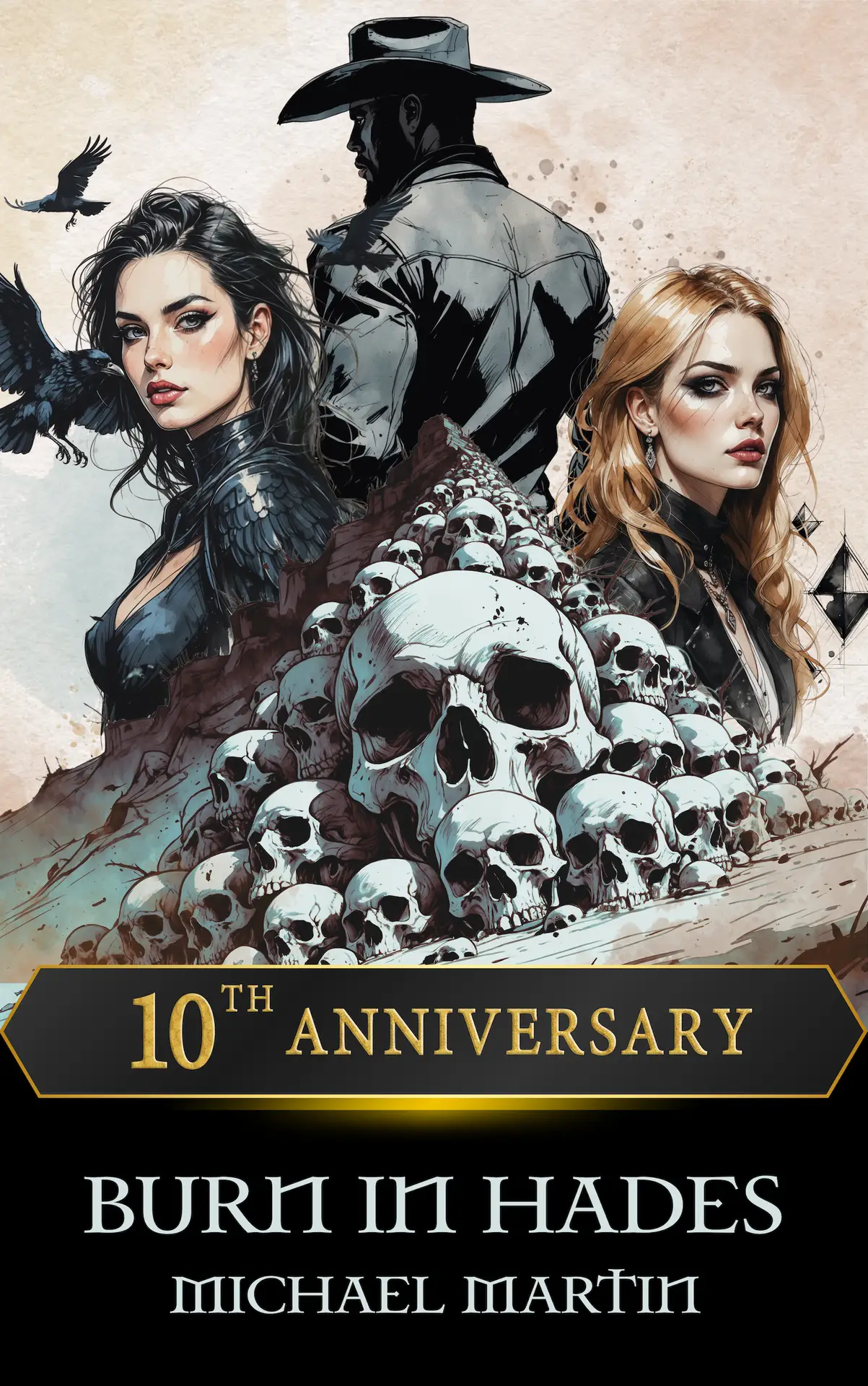
Burn In Hades is a visceral, high-concept dark fantasy novel in the Vaudeverse Saga by Michael Martin. It follows Cross, “The Man Who Remembers,” as he navigates a chaotic, multi-mythological Underworld. Blending arcane spiritual physics with macabre action, the story explores the brutal realities of “Second Death” and a cosmic war orchestrated by primordial deities.
The Anatomy of Damnation: Surviving Spiritual Physics
In Burn In Hades, the Underworld is not a poetic metaphor for regret; it is a violently tangible ecosystem governed by arcane spiritual physics.
The Vaudeverse treats damnation as a biological reality. Here, the air is choked with the metallic tang of blood and the suffocating odor of sulfur, and survival requires mastering the esoteric anatomy of the soul itself—specifically the Ruach (the spirit body) and the Nephesh (the reflexive core).
This is the crucible of the Vaudesy genre.
The ultimate threat within these shifting, fire-scorched skies is not mere suffering, but Second Death—the complete, horrific obliteration of the spirit.
As damned souls burn down into blighted, empty husks, the stakes of the narrative elevate from physical survival to absolute existential preservation.
The resulting Kinetic Dissonance is palpable. Michael Martin forces high-octane, brutal frontier action through the dense, oppressive gravity of cosmic horror.
Every swing of an obsidian macuahuitl and every round fired from a magical revolver is a desperate, bloody act of rebellion against a realm meticulously designed to erase you completely.
There is no passive observation here; there is only the frantic, visceral struggle to keep your soul intact.
Ruach
(The Spirit)
The tangible spiritual body and “outward” vessel that houses the core soul in the afterlife.
Nephesh
(The Soul)
The “inward part” or core soul containing the faculties of Mind, Emotion, and Will.
Second Death
(Burning)
The traumatic destruction of the spiritual body (Ruach) that leaves the soul vulnerable.
The Man Who Remembers: Cross and the Currency of the Past
To survive the Underworld is rare; to remember your life before it is nearly impossible.
Upon arrival in this fiery abyss, most souls are stripped of their mortal recollections, wandering as amnesiacs in the dark.
Cross—a former ranch hand carrying the weight of profound guilt—is the terrifying exception. Known throughout the shifting realms as “The Man Who Remembers,” he retains the full, agonizing clarity of his past.
Within the Vaudeverse, this does not make him a revered prophet; it makes him prey.
In a realm starved for the sensations of the living world, memories are the ultimate, coveted currency.
Demons and damned spirits actively hunt Cross, seeking to extract his past through violent decapitation to siphon the memories directly from his nephesh.
This macabre economy transforms Cross’s journey from a simple quest for salvation into a relentless, bloody bounty hunt where his own mind is the prize.
To protect his memories and his unique, spiritual bond with his monstrous mount, Gimlet, Cross relies on blunt, frontier brutality. Armed with an ancient obsidian macuahuitl and a magical Colt Peacemaker capable of absolute soul-annihilation, he navigates the cosmic nightmare with a “shoot first” cynicism.
Yet, beneath his abrasive humor and trail-hardened exterior lies a deep vulnerability. His ultimate mission to protect Cottontail, an ancient child goddess, forces him to use his violent skills not just for survival, but to defy the primordial entities orchestrating his suffering.
A Collision of Mythologies: The Master’s Chaotic Supercontinent
In traditional fantasy, pantheons are kept in their polite, designated realms. In Burn In Hades, they have been violently smashed together into a “Pangea-like” supercontinent. This catastrophic fusion is the work of The Master, a primordial sovereign who united the disparate realms of the afterlife out of sheer cosmic gluttony.
The result is a landscape defined by tectonic, mythological friction.
As Cross journeys through the Underworld, he doesn’t just cross geographical borders; he traverses entirely different systems of spiritual physics. The shadow-drenched Sumerian kingdom of Irkalla, ruled by Queen Ereshkigal, bleeds directly into the brutal, obsidian-edged ball courts of the Mayan Xibalbá. Above them all, the primordial Norse serpent Níðhöggr warps the very fabric of reality as it slithers through the fiery firmament, indifferent to the suffering below.
This collision creates a volatile, apocalyptic ecosystem. It is a world where Aztec blood-magic and esoteric Gnostic principles are weaponized by warring factions.
The Anarchists, wielding twisted scientific dogmas, wage endless, bloody trench warfare against the Tribulation, the zealot army of the primordial goddess Magna Mater. They fight over ancient, reality-bending structures like the Jnana Yoga Ladder, indifferent to the millions of souls caught in the crossfire.
In the Vaudeverse, the Underworld isn’t just a prison; it is a chaotic, collapsing empire where forgotten gods plot against each other, and the only universal law is the inescapable gravity of decay.
Xibalbá
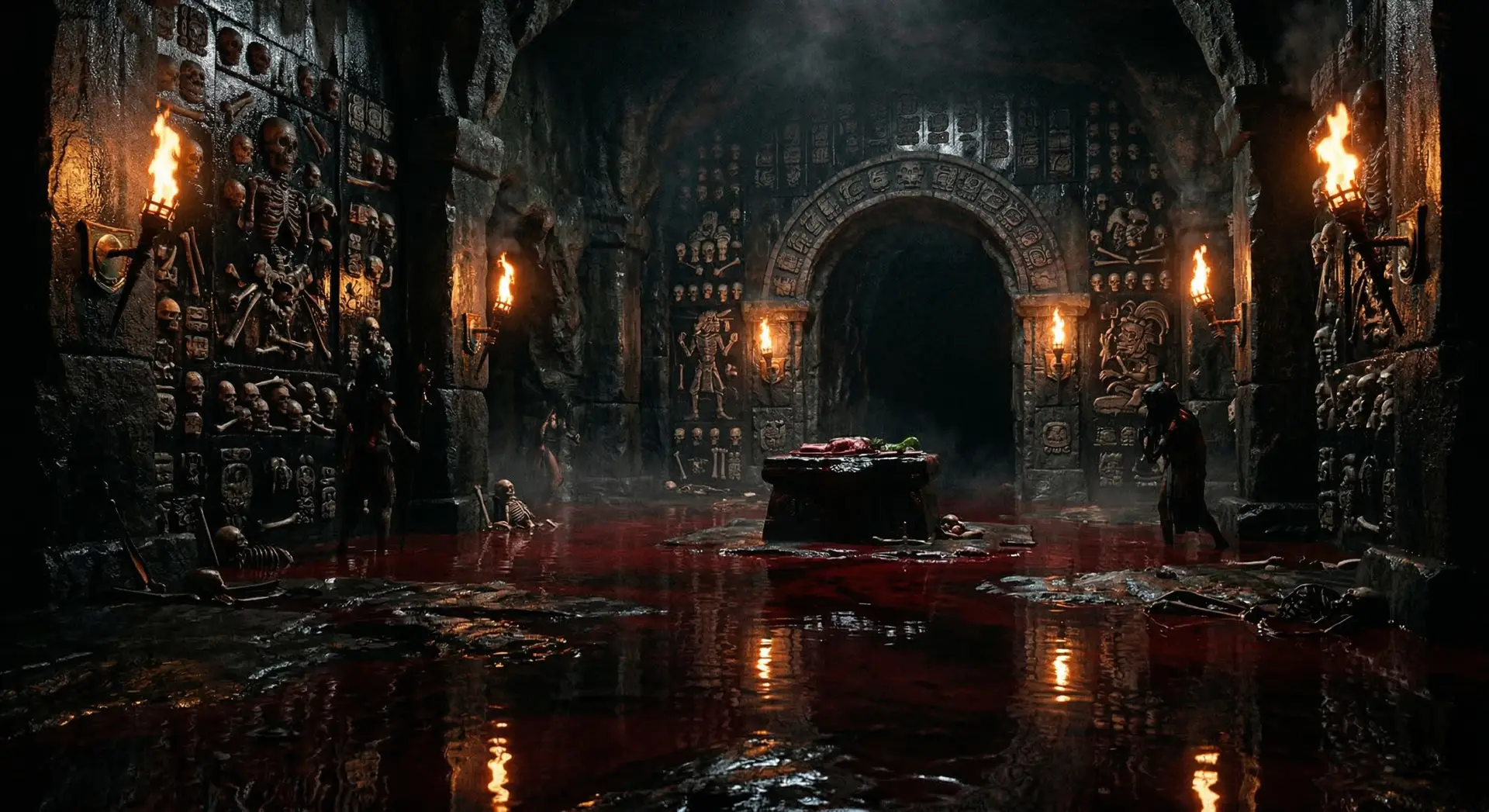
Xibalbá is a primal Mayan underworld forged from raw obsidian and blood-soaked jungle stone. This dominion is a theatre of violence, where powerful spirits compete in brutal ball games that mirror cosmic conflicts. To navigate Xibalbá is to risk total annihilation; it is a visceral crucible of kinetic agony, ruled by death gods who demand constant spiritual friction.
Irkalla
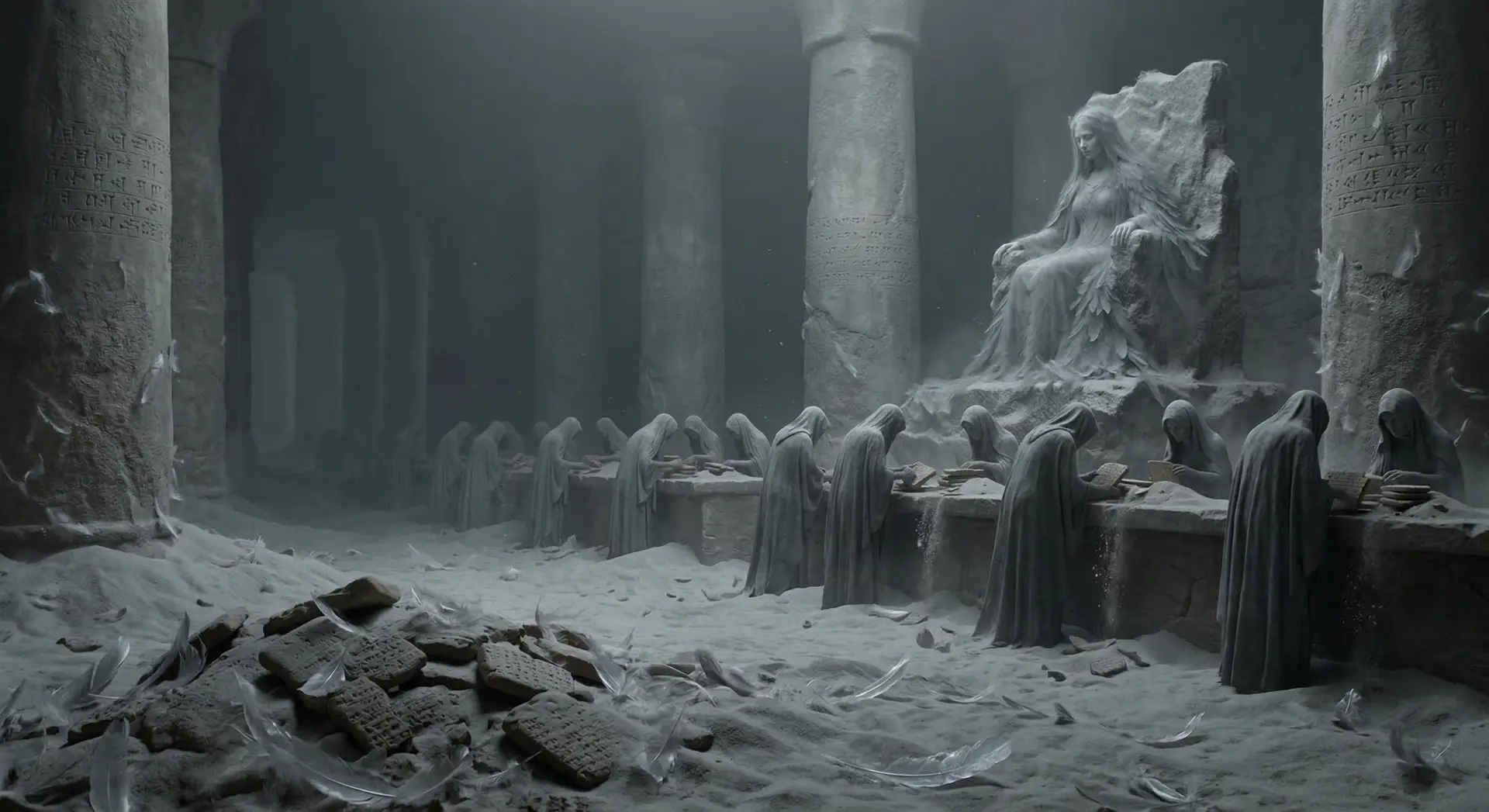
Irkalla is a Mesopotamian echo-chamber of eternal stagnation. It is a realm defined not by torture, but by fine ash and the molt of giant, invisible birds. Here, the shade of Queen Ereshkigal presides over a silent, grey bureaucracy of Second Death.
Naraka
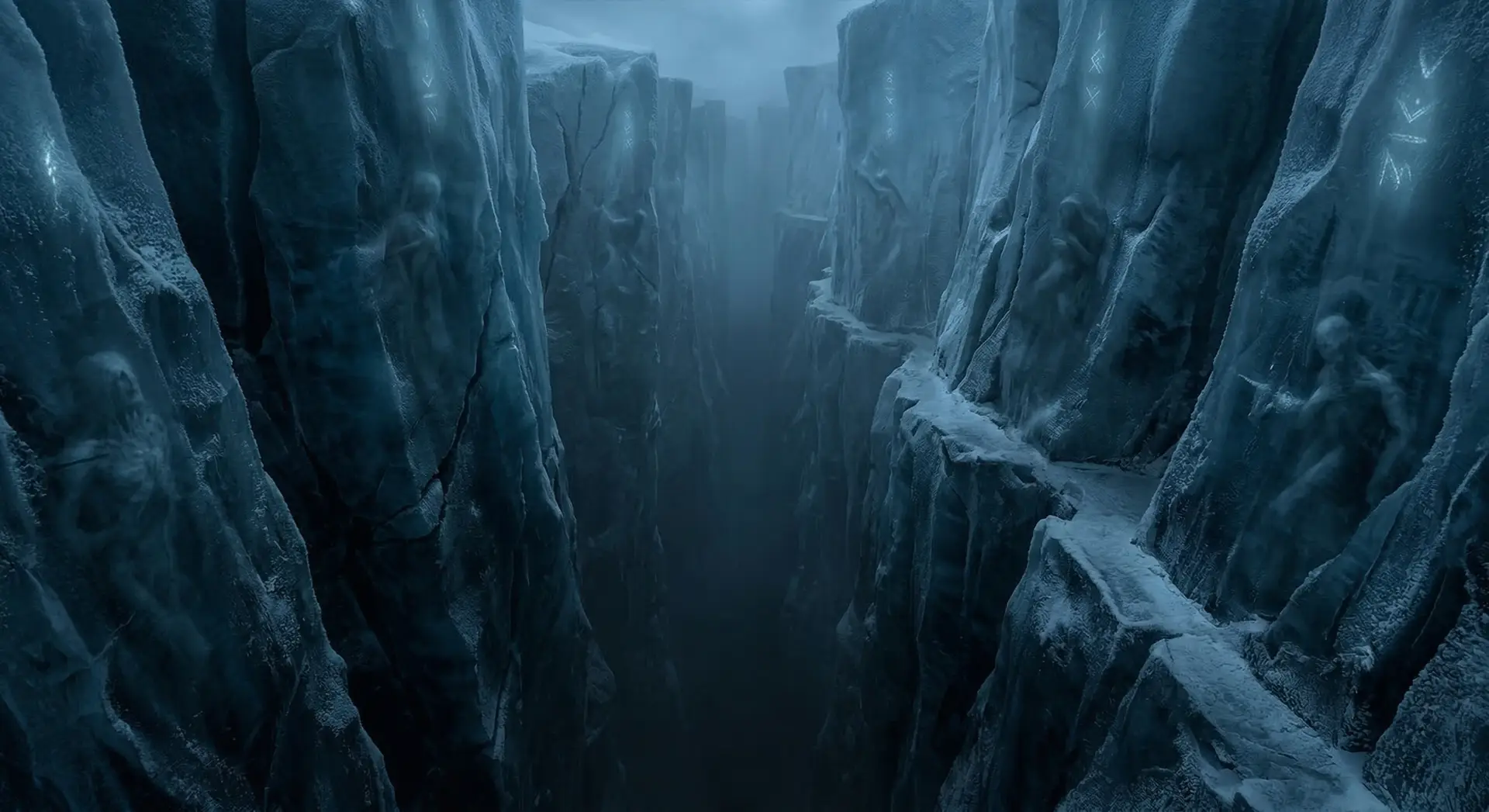
A domain of oppressive cold and vertical despair. The Vaudeverse interpretation of Naraka is a series of infinite, blue-black ice trenches descending into the deep abyss. Here, the concept of spiritual stasis is made manifest. Shades are trapped within the crushing weight of glaciers, their consciousnesses enduring freezing torments. Naraka represents the pole of maximum resistance, a silent, crushing counterweight to the chaotic activity of Xibalbá.
Warning for Travelers: A Symphony of Sorrow and Vengeance
To open Burn In Hades is not merely to begin a fantasy novel; it is to step into a crucible. Michael Martin has composed a narrative that demands endurance.
The prose is an unapologetic synthesis of high-octane, blood-soaked action and dense, esoteric atmosphere. It is a world where elevated, poetic philosophy regarding the anatomy of the soul collides violently with the blunt, brutal realities of frontier survival.
This book is a symphony of sorrow and vengeance. It does not offer the comfort of simple morality or easy victories. Instead, it immerses the reader in the claustrophobic dread of a universe where even the gods are succumbing to a cosmic cancer, and the protagonist’s only shield is a desperate, abrasive cynicism.
For the true Vaudesy reader, this is the ultimate draw. The novel’s Kinetic Dissonance lies in the friction between the awe-inspiring scale of primordial deities and the gritty, visceral reality of a man just trying to keep his head attached to his shoulders.
You will not just read about the Underworld; you will feel the heat of the magma, smell the sulfur of the Pit, and understand the terrifying physics of Second Death.
Prepare to navigate the dark, the beautiful, and the damned.
Reader Praise
"It’s rare that I read a book which transports me beyond enjoyment to pure excitement, but Burn in Hades by Michael Martin does just that.
Martin tells a compelling story about a former slave and convict’s journey through the underworld in search of redemption.
In reading Burn in Hades, I was amazed at the depth and breadth of Martin’s vision of the underworld and all its realms, from the ancient Egyptian Duat to an updated version of the Greek Charon to the magical calabash tree of the Mayan Xibalba.
As Cross is tormented with his memories of the life and people he left behind and the confusion around what led to his untimely death, he must also deal with underworld bounty hunters who prize those very rare memories his head contains—including one very special lady con-artist, The Raven, who becomes his mercurial partner and primary adversary.
Through Cross’ initial journey to rid himself of these tormenting memories, then his fight to keep the treasured knowledge those memories guard, he sorts through ideas of trust, forgiveness, and redemption. In the end, he must decide if he can trust The Raven to guide him to lead the resurrection of the dead, or if she has conned him into the ultimate, and final, second death.
I’m not sure if I’m more impressed with Martin’s fully-alive (but dead!) characters, his insightful concepts, his fast-paced storytelling, or his incredibly detailed world building, but what I know for sure is that I thoroughly enjoyed this read and cannot wait for the second book of the series!"
"Fantasy novels? Featuring the Greek Underworld? Oh my god must read"
"This is a good book with a message. Yes there is a moral message in it, but it is embedded within the different levels of fantasy with humor and a little mystery too.
Cross is a very lovable character, who learns a thing or two in the journey through the underworld.
A big plus for me was that Michael Martin combined many different religions together and formed an Underworld with all the different “hells” throughout it. He didn’t pick one religion that was the top dog but they each shared a place in the telling of the story.
I am looking forward to see what Cross gets himself into in the next installment."
"Kind of an odd book but I really enjoyed it. A story of a man’s attempt find redemption in Hades (Hell), and not in the way one might expect. I think it is really worth a read, funny, sad and just a little uplifting (not too much though)."
"This is not the kind of book you read for a moment of relaxed entertainment. It is epic, complex and even bizarre in a way. It reminded me of David Scott Hays Lucifer Morningstar, which is also quite utopian in the unique approach towards Hell and Heaven. You might want to take your time with reading it just so you dont miss any of the copious amounts of creative ideas flying around. As a reader I would suggest a glossary of words, places and people, because it is easy to lose track of who went where and why and is being eaten by what fantastical animal at this moment in time."
"Cross has the one thing most coveted by all the spirits of the underworld: his memories of a life before death. Unlike the other wandering souls, he remembers his family and loved ones, how he died and who he is.
There is a bounty on his head for his head and all the memories that come with it. He is hunted by gruesome hunchbacked demons, a fallen angel, ferocious hellhounds and demonic animal-hybrid creatures.
We follow him on his journey through the underworld amiss the eerily mystifying realms of Xilbaba, Vinsuale and Amenthes, among countless more. However, there is more to this book than what is written on the back cover.
Burn in Hades is not simply a novel about “The Man Who Remembers” seeking a normal afterlife on his quest to erase his memories in the river of Paradise. That is only half the story.
Burn in Hades is written from the point of view of three characters: Cross–an unforgiving soul who died in the late nineteenth century; Raven–a stoic fallen angel with rapturous black wings, neither at peace among the demons or among the blessed; and Diamond Tooth–the beautiful and deadly demon of pain and suffering. All three wish to escape the underworld and seek a rare astrolabe that will unlock the gate that leads to the realm of the living…but they have no idea they need each other to complete their goal.
Michael Martin links the underworlds of different cultures, creating ’realms’ within his layered hell, as a multi-cultural and modern salute to Dante’s Inferno. He writes with an enthusiasm for detail. His descriptive passages and fast-paced style certainly keep the story moving, but can at times leave you out of breath. At certain points in the novel, I found myself asking, “Wait, where am I?” and just when I thought certain characters had accomplished one task, Martin switches the plotline to something more dynamic, as if the characters realized what they wanted was not enough."
"Naming his protagonist “Cross” in a novel about Hades is definitely a tease. And given that his path remains a rocky road, the ever-stubborn Cross hasn’t experienced much personal growth along the way, leaving Salvation an ever-distant goal. Cross is in Hell, but whose Hell is it, and by whose definition. Is it Dante’s? Is it someone else’s perception? Or is it truly Cross’ own interpretation that has created the habitat that he shares with others? We find Cross about to undertake a selfless mission—rescuing his neighbor, who has been eaten, perhaps, by something that travels underground.
Along the way, Cross has several adventures, meets some lovely ladies, and continues to mull breaking into Heaven. We meet characters from his past, and characters from other religions, some hindering, some helping him to meet his goal, as Cross continues blithely on in his quest. Layer upon layer of ambiguity and puzzles confound us probably more than they do Cross. After all, this becomes our journey as well.
Even if Cross hasn’t learned anything by the end of his journey, that can’t be said for the rest of us. Cross suffers so that we may learn.
I’m looking forward to the next two installments, but will have to dive in again to see if I can pick up anything else as I re-read. Like every great book, there’s always a different perspective, and who is to say what is right? It was a pleasure to find a first time author who had obviously developed a world, a backstory, and an editor. Kudos. "
"Michael Martin takes his reader into an epic journey with Cross through Hades, hell, underworld or similar concepts come into mind: Burn in Hades. Michael Martin is an author of fantasy who believes magic should always be magical because it’s, well, magic. It’s Martin Jr. first book in The Life After Death Trilogy.
Martin combines names and ideas about devils, demons, torture, first and second death, Charon, punishment to create his version of hell. Cross never forgives because he never forgets. He is the only one that remembers. Glimpses of his earthly–sinful–life as Charles Hill are interwoven in his journey to reach the last Toran and climb up to paradise.
Cross didn’t drink from the river Lethe which causes complete forgetfulness. Not that he’s not haunted by evil spirits trying to hinder him from reaching his goal and steal memories. Paradise is guarded by a great wall that annihilates any soul that gets too close. No member of the damned has ever broken in. Creatures like gimlets, squals, Nothings cannot be trusted.
The storyline is full of skulls, death, evil and unworthy friends. From the Egyptian Duat to an updated version of the Greek Charon to the magical calabash tree of the Mayan Xibalba. It’s the right place to throw “what the hell’s” and “who the hell” into conversations.
Cross (Charles Hill), as well as other souls named Ms Blankface, The Raven, Clem Balfour (Tivoli) all are described in detail. Avoiding explicit Christian, Muslim, Jewish or pagan beliefs, it’s the last Toran (Torah meets Qur’an) they’re looking for. Objects are weapons and kind of money. Of course there are weapons, but mostly without any damage at all. Second death has to be a special occassion. Praying is done to The Great Goddess. Only once in the book God is mentioned, maybe an editorial mistake. The regions in the underworld are worked out on a great map. It’s the fantasy aspect that keeps the reader entertained and engaged. Will Cross be the one to open up the way to paradise?"
"Was thinking about Burn in Hades just the other day. It’s such a powerful book, it stays with me."
Plunge into the fiery chaos
Descend into the visceral, high-concept dark fantasy of Burn In Hades.
Follow Cross, The Man Who Remembers, as he navigates a chaotic collision of mythologies, fights off Second Death, and survives the Underworld.