
The Death of Belle Lettres: A Satire on BookTok & The Attention Economy
The Death of Belle Lettres is a satirical short story by Michael Martin formatted as a true-crime podcast. It investigates the murder of ‘Ms. Fiction’ by a rogue’s gallery of algorithmic villains, exploring how shortened attention spans, aesthetic filtering, and audience apathy are destroying deep reading.
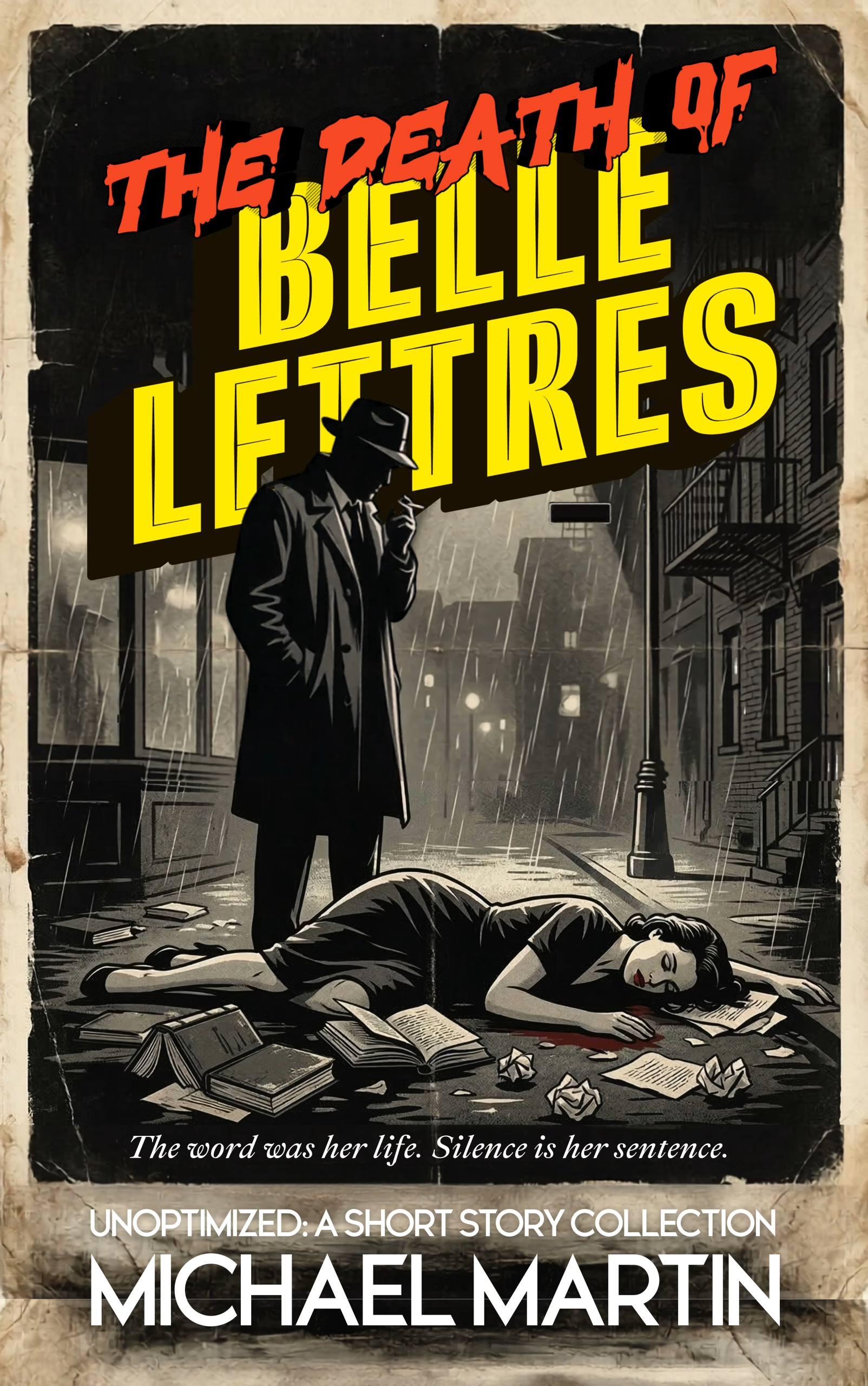
The Murder of Ms. Fiction
They found her body in the Narrative Graveyard. It wasn’t pretty. Her spine was snapped. Her pages were torn, with sprayed-edge wounds. Her budget was cut, sliced with razor-thin margins. Superficial, but deep enough to bleed. And she was covered in neon sludge, academic red ink, and… glitter? Ms. Fiction. Belle Lettres. The “Novel.” Whatever you called her, she’s dead.
Welcome to Episode 14 of Dead Air. Within the Vaudeverse, The Death of Belle Lettres operates as a direct indictment of the modern publishing landscape. It weaponizes the familiar, voyeuristic format of a true-crime podcast to conduct an autopsy on the written word.
This story is not a gentle critique. It is a high-speed, over-stimulated descent into the homogenization of art. When books are reduced to “content,” when nuance is deemed “exclusionary,” and when literature is forced to survive the aesthetic shield of the “Infinite Feed,” the story itself is dismantled piece by piece. Here, Kinetic Dissonance is achieved by contrasting the mournful, rain-soaked noir of a dead art form with the frenetic, headache-inducing EDM of the dopamine economy.
The Rogue's Gallery of Algorithmic Villains
She didn’t die instantly. She was dismantled, piece by piece, by five specialists. I sat down with them. And let me tell you… this interview didn’t go as planned.
Through the framing of the Dead Air podcast, the host tracks down the exact forces responsible for the lobotomization of modern storytelling. These are not traditional monsters; they are the personified mechanics of the attention economy:
- Dr. Dopamine: Operating out of “The Infinite Feed,” he represents the weaponization of pacing. He uses a “P300 Dampener” to suppress deep reading, demanding that narrative be reduced to viral 15-second emotional spikes.
- Baron BookTok: The self-proclaimed “King of Vibes.” He trapped Ms. Fiction in a “Filter Bubble,” dictating that if a story lacks “sprayed edges” or trending tropes like “Enemies to Lovers,” it is entirely invisible to the market.
- The Emeritus (Dean Dumb-Down): A critique of literary homogenization, he runs “The Remedial Ward” and excises the pleasure centers of the brain. He views nuance as exclusionary, forcing the narrative into Basic English to democratize the comprehension curve.
- Simulacra & Apex: The forces of gamification and corporate starvation. Simulacra traps the story in a “Prestige Loop” of AAA cutscenes, while Apex, a bloated corporate monopoly, cannibalizes the midlist author and hides the surviving narrative behind aggressive micro-transactions.
But the true horror of this satire isn’t just the corporate dismantling of art. The autopsy confirms that despite the lobotomy, the cosmetic surgery, the red ink, the gamification, and the starvation, Ms. Fiction was still alive on the operating table.
These five villains only softened her up. Someone else pulled the plug.
Do Not Swipe Left
Who really killed Belle Lettres? Who dealt the final, fatal blow to deep reading and narrative nuance?
The Death of Belle Lettres is a mirror held up to the modern consumer. It asks uncomfortable questions about our own complicity in the destruction of the art we claim to love. If you are ready to find out who is hiding in the “Court of Public Opinion”—and if you have the endurance to face the Kinetic Dissonance of the truth—do not swipe left. Keep reading.