
The Neurologist: A Psychological Speculative Fiction on the Necessity of Storytelling
The Neurologist (Case 88) is a speculative short story by Michael Martin formatted as a 19th-century clinical log. It documents a horrifying experiment to surgically cure a patient of imagination, ultimately proving that fiction is not an escape from reality, but the essential biological software required for empathy, innovation, and survival.
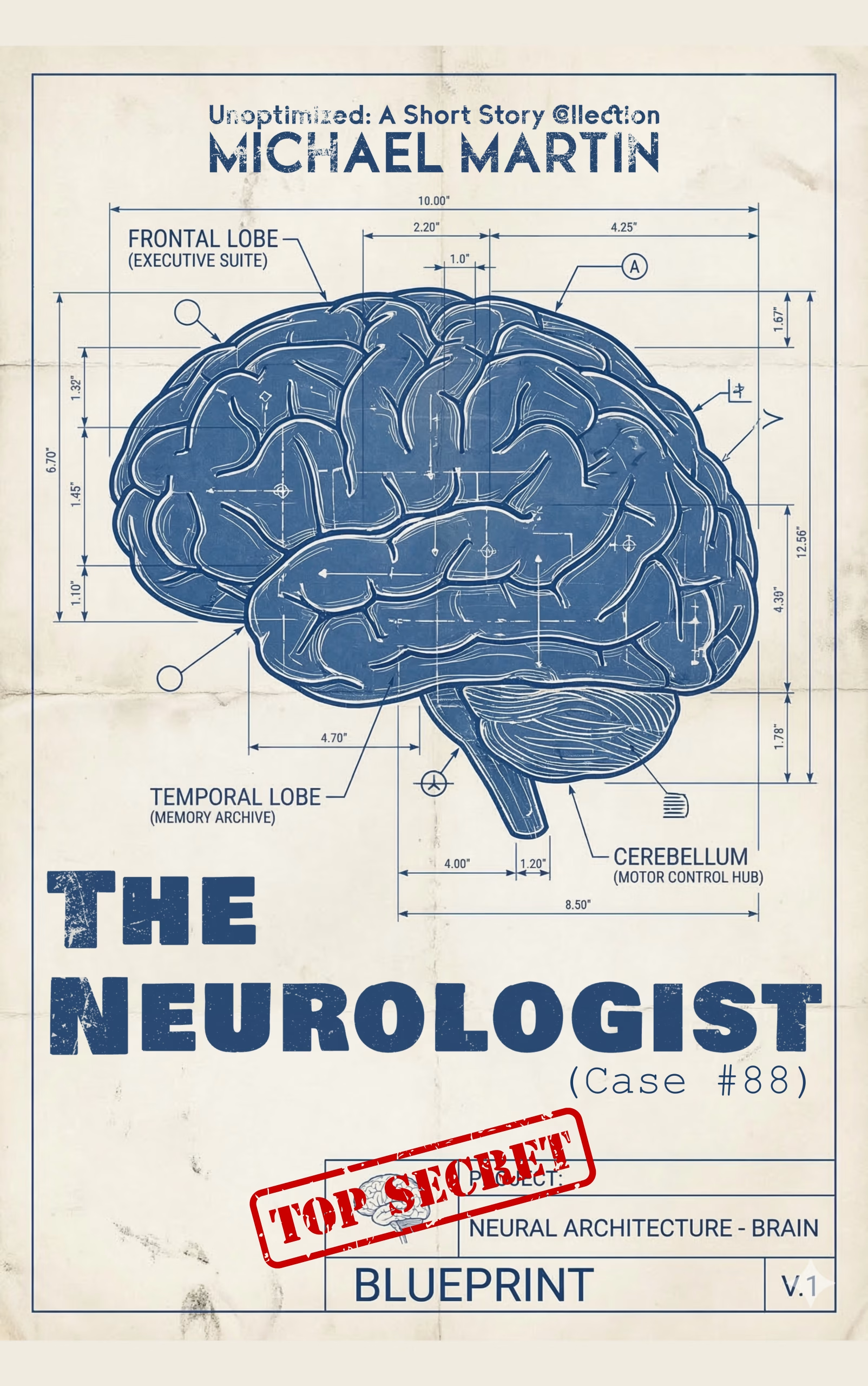
The Fictive Cortex
CONFIDENTIAL PATIENT FILE: CASE #88
PRESENTING COMPLAINT: Chronic “Narrative Drift.” The patient describes an inability to focus on raw data without his mind “wandering into the hypothetical.” He desires total linearization of thought.
PROCEDURE: Bilateral Anterior Lobotomy of the Fictive Cortex. (Targeting the neural pathways responsible for counter-factual simulation, metaphor, and abstract synthesis).
OBJECTIVE: To create the “Perfect Pragmatist”—a human consciousness capable of processing objective reality with zero subjective distortion.
Welcome to the Oculum of Rational Alignment. Within the Vaudeverse, The Neurologist serves as the philosophical bedrock of the entire Shadow Archive. It operates as a direct counter-attack against modern “hustle culture” and the hyper-utilitarian belief that art, nuance, and storytelling are inefficient distractions from raw productivity.
By framing this defense of literature within the sterile, horrifying constraints of a 19th-century medical log, the narrative strips away the romanticism usually associated with art. It replaces it with cold, hard biology. The Kinetic Dissonance here is found in the terrifying realization that removing a person’s ability to “hallucinate” the unreal does not make them a better worker; it makes them fundamentally incapable of being human.
The Perfect Pragmatist
POST-OPERATIVE OBSERVATION: DAY 14
The subject is entirely tethered to the literal present. The procedure was a success. However, severe behavioral anomalies have manifested.
- When asked to evaluate the suffering of another patient, Subject 88 stared blankly, stating, “I am not experiencing that pain. Therefore, it is irrelevant.”
- When a localized fire broke out in the ward, the subject made no attempt to evacuate. When questioned, he stated, “The flames had not yet touched my skin. To act prior to combustion would be to react to a phantom.”
CONCLUSION: The Fictive Cortex is not a vestigial organ of entertainment. It is the anatomical seat of survival.
In The Neurologist, the surgical removal of imagination proves disastrous. The text brutally deconstructs the modern obsession with pure, data-driven pragmatism by demonstrating what happens when a human mind is actually stripped of its ability to “hallucinate.”
The experiment reveals that fiction is the core biological software required to operate a human being. Without the capacity for narrative, the patient experiences three fatal system failures:
- The Death of Empathy: To feel empathy, the brain must be able to construct a counter-factual simulation—a fiction—of what it feels like to be inside another person’s circumstances. Stripped of this ability, the patient becomes functionally psychopathic.
- The Death of Innovation: Progress requires the ability to look at a piece of wood and hallucinate a wheel. Because the patient can only perceive what is, he is entirely incapable of conceptualizing what could be. He is trapped in the static, unchanging present.
- The Death of Survival: The human brain keeps us alive by constantly spinning fictional, “what-if” scenarios about the future. Without the ability to imagine a fire spreading or a predator attacking, the patient cannot anticipate danger. He loses his instinct for self-preservation because the future itself is technically a fiction until it happens.
The story ultimately proves that art is not a luxury. The Kinetic Dissonance we experience when reading a difficult, complex narrative is a neurological workout, keeping the very faculties that make us human from atrophying.
The Truth is a Cage
FINAL ENTRY: DAY 42
Subject 88 is perfectly optimized for the modern economy. He does not dream. He does not rebel. He processes data with absolute efficiency and possesses no empathy to slow his labor. He is the ultimate, frictionless machine. We have cured him of his humanity. God help us.
The Neurologist serves as the ultimate defense of the Vaudeverse. If we continue to view art, nuance, and imagination as mere “content” to be consumed or inefficiencies to be optimized away, we will willingly lobotomize ourselves.
The truth, unvarnished by narrative, is a cage of static data. It is the fiction—the “hallucination” of what could be—that gives us the capacity to break out of it.
If you are tired of the sterile, frictionless reality of the modern web, it is time to exercise your Fictive Cortex. The stories in the Shadow Archive are not designed to be easy. They are designed to induce Kinetic Dissonance and remind you that you are still alive. Stop optimizing. Start reading.