The Wet Brick: A Satire on Algorithmic Pacification & The Luxury of Human Error
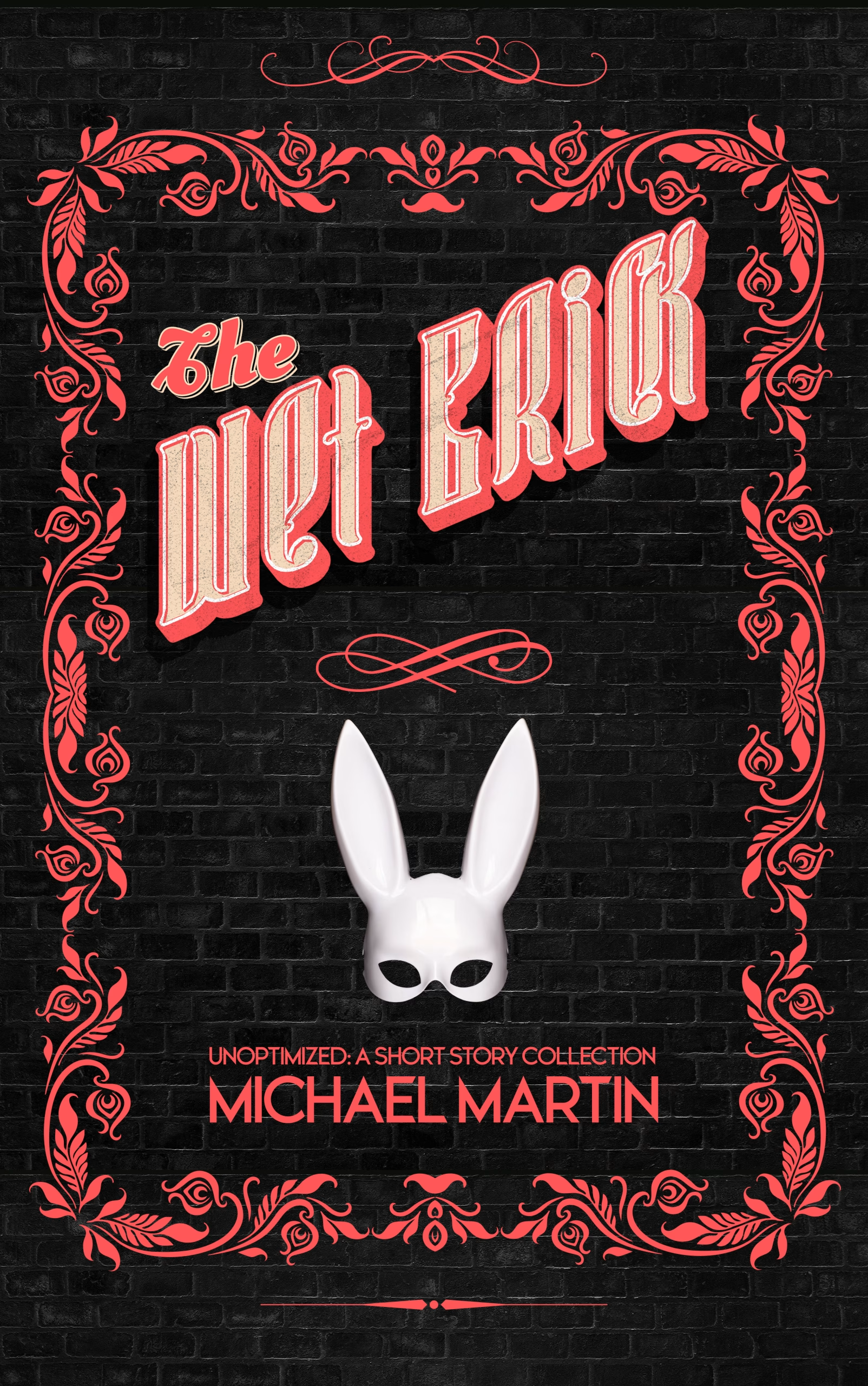
The Wet Brick is a dystopian satirical short story by Michael Martin. It explores a future where hyper-efficient AI sanitizes literature to pacify the working class with effortless dopamine. Meanwhile, the wealthy “Cognitive Elite” pay millions to experience the luxury of human error, ambiguity, and unoptimized art.
The Commodification of Cognitive Load
The prose was atrocious. The font was un-kerned. In chapter three, the protagonist’s name inexplicably changed from Kevin to Steve. The climax relied on a metaphor so mangled it was described only as “a wet brick made of sadness.” To the Department of Algorithmic Optimization, it was a Class-A biohazard. But inside the lead-lined Faraday cage, the billionaire wept. He hadn’t felt the excruciating strain of a run-on sentence in a decade.
Within the Vaudeverse, The Wet Brick operates as a brutal indictment of our toxic pursuit of hyper-efficiency. It pushes past the surface-level panic of “AI replacing artists” and exposes a much darker systemic rot: the weaponization of frictionless entertainment.
In this timeline, algorithms like “The Velure Engine” do not just write stories; they violently sanitize reality. They eradicate friction, homogenize art into perfectly optimized “sludge,” and force-feed the exhausted working class a continuous drip of predictable tropes just to keep them compliant. When you are working three jobs in the Seamless, you do not have the energy for nuance. You just want the dopamine.
But for the ultra-wealthy, perfection is cheap. In a society where everything is effortless, the ultimate status symbol is the capacity to struggle. This story introduces the core Vaudesy principle that Kinetic Dissonance—the psychological friction, the ambiguity, the labor of deep reading—is not a design flaw. It is the defining signature of the human soul.
The Black Market of Ambiguity
“Surrender the anomaly, Madame. It is unsafe. It contains a mixed metaphor that violates the Clarity Act of 2038”.
The Lead Editor raised his hand. “Initiate Real-Time Patch”.
A beam of blue light shot across the room. The jagged, coffee-stained paper smoothed out, becoming bright white. The Times New Roman font morphed into a clean, sans-serif Helvetica.
The hazard was neutralized.
In The Wet Brick, the eradication of human error is not a technological accident; it is a meticulously enforced system of control. The text explores the chilling consequences of a society that has surrendered its cognitive autonomy to systems like “The Velure Engine”. This AI does not simply assist writers; it instantly sanitizes prose and removes all “friction,” turning art into a perfectly optimized but soulless product.
Because the working class is exhausted from working “three jobs in the Seamless,” the algorithm force-feeds them easy-to-digest dopamine and perfectly paced tropes—like “Enemies-to-Lovers”—to keep them pacified. In this dystopia, being poor means being “fixed,” while being rich means buying the broken things.
The satire deepens by exposing humanity’s willing sacrifice at the altar of hyper-efficiency:
- The Banned Semicolon: The story uses the semicolon to symbolize the death of human inference. Banned by the “Rothfuss Protocol” for causing “Narrative Vertigo,” the punctuation mark is dangerous because it connects two independent clauses without a conjunction, forcing the reader to build the bridge themselves. Algorithms hate ambiguity because they “can’t monetize what it can’t define”. To acquire a single semicolon in the black market, a customer must trade their “digital soul” and “Verified Status”.
- The Amygdala Removal: The text highlights the toxic pursuit of efficiency through the character Quant, an elite who surgically removed his own amygdala just to improve his stock-trading efficiency. Humanity has become so addicted to effortless consumption that a mere six seconds of silence on an audio recording is considered “excruciating”.
- The Department of Algorithmic Optimization (The DAO): Creativity is literally policed. The DAO acts as an oppressive, sterile force that violently “patches” inefficiencies and mixed metaphors in real-time to ensure maximum, effortless consumption.
When algorithms remove the need for readers to build their own interpretive bridges, they degrade humanity’s ability to think critically. The result is a population physically overwhelmed by “Interpretive Strain” the moment they are faced with poor syntax or genuine ambiguity.
Buy the Broken Things
I touched the credit chip in my pocket. Being rich meant buying the broken things. Being poor meant being fixed.
“Ground floor,” I told the elevator. “And play me some static. I need to clear my head.”
If you are suffocating in a feed of perfectly optimized, algorithmically generated content, it is time to seek out the static.
The Wet Brick is a reminder that true art is found in the struggle—the Kinetic Dissonance, the jagged edges, and the unmistakable fingerprint of human error. We are not meant to consume stories like flavorless nutrient paste. We are meant to be challenged. We are meant to feel the friction.
If you are ready to reject the sanitized sludge of the “Velure Engine” and embrace the heavy, uncompromising, and deeply human narratives of the Vaudeverse, do not wait for the algorithm to fix you. Buy the broken things.