Overview
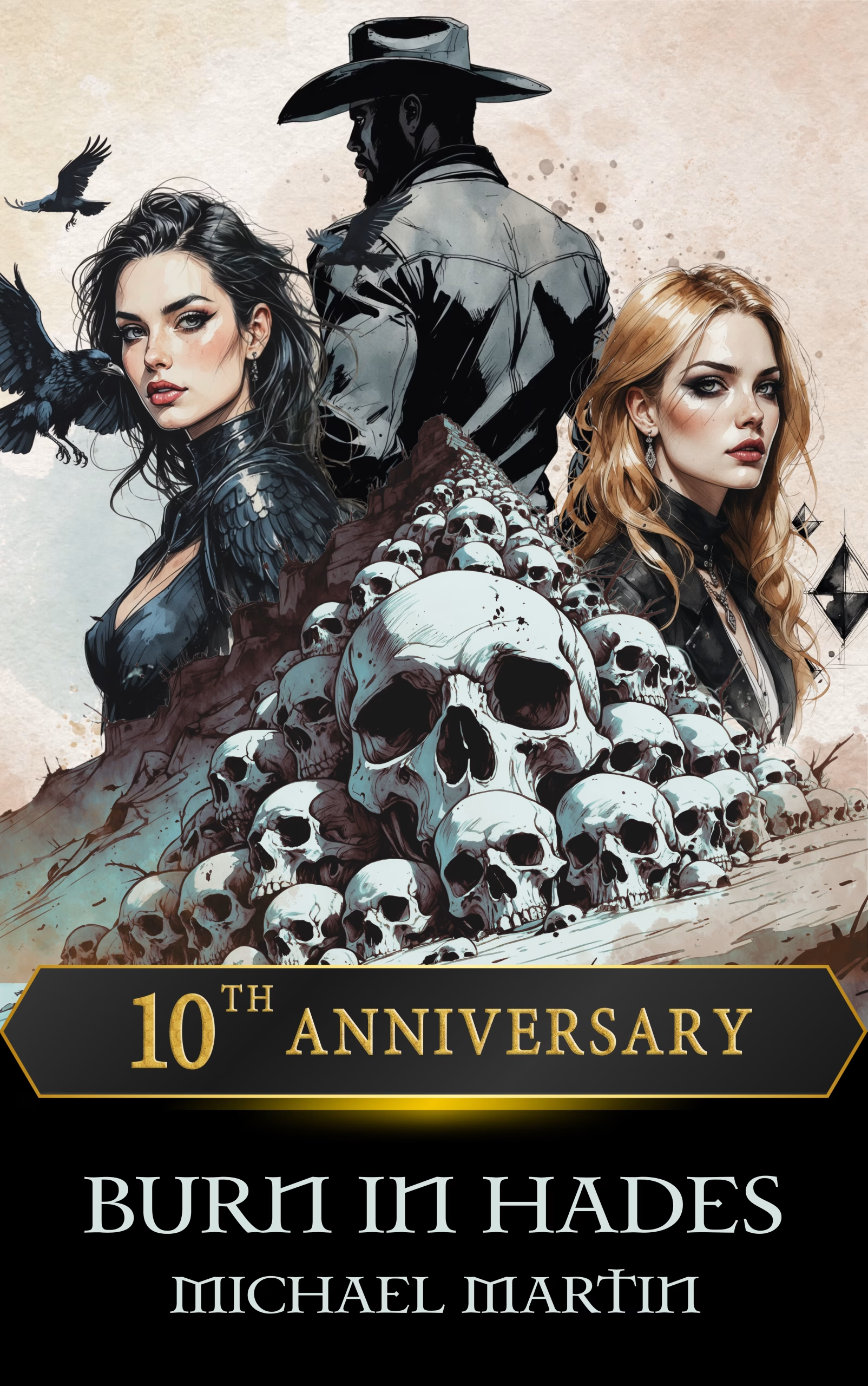
Mythological Brutality is a speculative fiction framework created by Michael Martin in the Vaudeverse Saga (specifically Burn In Hades). It features an intentional collision between elevated, multi-pantheon cosmic scale and unvarnished physical decay, testing human resilience against indifferent, predatory divine systems rather than wallowing in empty Grimdark nihilism.
For years, the dark fantasy landscape has been choked on its own cynical exhaust. Everywhere you look, standard Grimdark offers the same tired formula: a muddy ditch, a protagonist who behaves like an unwashed sociopath, and a narrative world-view asserting that because everything is broken, nothing matters.
It is fast-food misery—a sterile, algorithmic exercise in shock value designed to be speed-read and immediately forgotten.
When I researched how modern readers react to dark fantasy, I found a profound, unspoken exhaustion with polished “clean magic” and sanitized deities. My readers didn’t want shallow nihilism, nor did they want sanitized pantheons where gods act like benevolent corporate HR managers.
They wanted something raw, heavy, and resonant.
That is why I architected Mythological Brutality. It is the aesthetic antidote to shallow fiction—the intentional crash between divine grandiosity and unvarnished physical suffering. It is what happens when ancient lore is dragged down into the sulfur, mud, and black ichor of human reality.
What is Mythological Brutality? In simple terms
Quick Answer
Mythological Brutality is a speculative fiction framework where ancient, elevated mythic scale collides with visceral physical decay, existential dread, and unyielding environmental friction. Unlike traditional Grimdark, it uses the clash between divine indifference and mortal endurance to highlight the stubborn, refusal-to-shatter nature of human agency.
In simple terms, Mythological Brutality strips the romanticized paint off ancient myth.
If classical myth views the gods as majestic statues on a marble hill, and Grimdark views the world as a meaningless pile of garbage, Mythological Brutality treats ancient gods as predatory landlords running a cosmic tenement building. The architecture is ancient and magnificent, but the pipes are leaking toxic Devils Water, the rent is charged in human regret, and the landlord doesn’t even remember your name.
It is not merely a setting; it is a structural commitment to friction. In a Vaudesy narrative, the environment itself is an active adversary. The Underworld sky is a garish canopy of shifting firestorms. Magic isn’t a clean wrist-flick; it is heka—a heavy, volatile force that burns the user’s spiritual form (Ruach) if wielded without absolute resolve.
It drags the grandest theological concepts down to the dirt, forcing mortals to fight for their identity using whatever ordinary artifacts (Divine Chattel) they can scrape out of the ruins.
The Three Markers of Mythological Brutality
Quick Answer
Mythological Brutality operates through three non-negotiable structural markers: Systemic Indifference Over Active Malice, where deities treat mortals as fuel or background noise; Visceral Physicality, where spiritual forms bleed black ichor and suffer physical decay; and the Aesthetic of Decay, where mythic structures exist as crumbling monuments of petrified suffering.
Marker 1: Systemic Indifference Over Active Malice
In standard, sanitised fantasy, gods act with personal focus—they either bestow divine blessings or actively strike down mortal transgressors. Mythological Brutality rejects this anthropocentric narcissism.
In a Vaudesy narrative, primordial entities like Anu or The Master of the Underworld do not hate mortals; they simply do not acknowledge human individuality as anything more than fuel or currency.
The Underworld isn’t built to punish you specifically—it is a dynamic cage, an amalgamated supercontinent of fractured mythologies that operates with the cold, administrative efficiency of a slaughterhouse.
To The Master, a human soul (Nephesh) isn’t a sacred vessel for moral redemption—it is a “savory snack” to be harvested, siphoned, and processed to maintain the structural integrity of his domain. Deities operate like predatory landlords; they don’t care about your backstory, your tears, or your heroic destiny—they only care about collecting rent in the form of your memory, your suffering, and your black ichor.
Marker 2: Visceral Physicality (The Ruach Friction)
Magic in Mythological Brutality is never a clean, wrist-flick exercise in glowing hand-gestures. It is a heavy, volatile force called heka—a spiritual mechanic that leaves physical scars on the wielder.
In the Vaudeverse, the afterlife doesn’t grant you an ethereal, weightless ghost-form. You exist in a Ruach—a tangible spiritual body composed of astral flesh, an aetheric skeleton, and black, viscous ichor that functions as motor oil for the soul.
When a spirit is wounded by an obsidian-bladed macuahuitl or struck by lightning from the burning sky, they don’t simply fade away. They bleed black ichor that sizzles on the parched red dunes.
If they overextend their spiritual form or succumb to environmental trauma, they suffer Second Death (Burning). Their Ruach disintegrates into a brittle, charred husk—a Blighted Spirit that retains only a reflexive, screaming consciousness inside its core soul (Nephesh).
Existence in a Vaudesy universe is a constant, grinding physical friction against an environment designed to wear you down to ash.
Marker 3: The Aesthetic of Decay
The geography of Mythological Brutality is built on the wreckage of shattered pantheons. You will not find pristine marble temples or sanitized, glowing halls in the Vaudeverse.
Instead, you tread across the Pangea of Ruin—a supercontinent where Mesoamerican ball courts, Mesopotamian ziggurats, Norse frozen wastes, and Biblical hells have been violently smashed together during the Eternal War.
The architecture itself is constructed from petrified suffering.
Structures like the Temple of Skulls loom over waste-fields of sulfur and ash. Devils Water flows with flammable, opaque sludge that smells of sulfur and expired dreams, serving as both a toxic beverage for the damned and a volatile accelerant for weapons.
Titanic, mobile geological beasts called Xrafstars stride across the landscape, carrying entire pygmy settlements on their moss-choked backs while geysers of putrid devils water erupt from their veins. It’s an aesthetic where the grandeur of ancient myth is permanently stained by the unvarnished reality of physical rot.
Mythological Brutality vs. Grimdark: Why Endless Nihilism Fails
Quick Answer
While Grimdark presents a flatline of moral nihilism where human choices are meaningless in an irredeemable world, Mythological Brutality uses extreme cosmic hostility as a forge. It rejects flatline misery, using the clash between divine indifference and mortal suffering to emphasize the stubborn, refusal-to-shatter nature of human agency and memory.
| Feature | Standard Grimdark | Mythological Brutality (Vaudesy) |
|---|---|---|
| Core Worldview | Nihilistic; everything is broken, nothing matters. | Existential; the world is hostile, but human agency is sacred. |
| Protagonist Arc | Moral degradation into sociopathy or despair. | Stubborn endurance; clinging to True Names and memory. |
| Tonal Range | Flatline of unrelenting misery and mud. | Kinetic Dissonance; jagged swings between cosmic horror and dark wit. |
| The Stakes | Mean-spirited survival in a meaningless void. | Theological weight; testing the soul against predatory divine systems. |
The dominant trend in dark fantasy over the last two decades—frequently labeled Grimdark—has backed itself into a creative dead end.
By asserting that every character is a secret sociopath, every institution is irredeemably corrupt, and every effort at decency is rewarded with a knife in the back, Grimdark flattens the narrative EKG into a lifeless horizontal line.
When misery is constant, misery becomes boring. If nothing matters, why should the reader turn the page?
Mythological Brutality explicitly rejects this flatline. It operates on the principle that extreme environmental hostility is interesting only because of the human resilience that fights back against it.
In Burn In Hades, the protagonist Cross (Charles Hill) is subjected to a century of twisted, psychological captivity under the demoness Diamond Tooth. He is hunted across tangerine-sky infernos by eyeless squals that want to crack his skull and feast on his memories.
Yet, Cross does not collapse into a nihilistic puddle. He clings to his True Name, his mortal memories of the American Old West, and his ironclad oath to rescue the child-goddess Cottontail.
The brutality of the mythos exists to elevate the hero’s refusal to shatter. Human agency, memory, and stubborn defiance mean more when set against the backdrop of a roaring cosmic furnace, not less.
Mythological Brutality delivers the grit and the blood, but it anchors them to an unyielding core of human heart.
How Do Dark Fantasy Works Build Mythological Brutality?
Quick Answer
Mythological Brutality is engineered by bridging the poetic, unsparing violence of Western Gothic literature with the fragmented, environmental storytelling of modern dark fantasy games. It strips away clean magic systems, replacing them with visceral physical consequences, ancient architectural decay, and protagonists who rely on ordinary mortal artifacts to survive predatory cosmic systems.
Comparative Bridge 1: Cormac McCarthy (Western Gothic)
Cormac McCarthy’s influence on Mythological Brutality lies in his masterclass of contrast: weaving elevated, almost biblical diction directly alongside abrupt, unvarnished violence and hostile, untamed frontiers.
In McCarthy’s Western Gothic masterpiece Blood Meridian, the desert is not merely a setting; it’s an indifferent, blood-soaked altar where human morality is stripped to the bone.
Mythological Brutality adopts this exact structural friction.
In a Vaudesy narrative, the prose alternates between high-concept theological weight and the gritty, unpolished reality of survival.
When the protagonist Cross (Charles Hill) navigates the Underworld, the narrative doesn’t gloss over the physical mechanics of his suffering.
The atmosphere tastes like charcoal and sulfur, his Ruach (spiritual body) bleeds black ichor onto the parched dunes, and the dialogue remains grounded in the laconic, cynical wit of an Old West ranch hand who refuses to be intimidated by a screaming sky.
Comparative Bridge 2: FromSoftware / Elden Ring (Environmental Horror)
FromSoftware’s worldbuilding philosophy—exemplified in Elden Ring and Dark Souls—is the gold standard for environmental storytelling.
Their worlds are ancient, shattered, and utterly indifferent to the player’s presence. The lore isn’t handed to you in a neat exposition dump; it is fragmented, embedded in the very architecture, carved into the stone of crumbling ziggurats, and hidden within the item descriptions of rusted weapons.
Mythological Brutality translates this visual and atmospheric sensibility directly into prose through Anti-Skim Architecture.
The universe of Burn In Hades existed eons before the reader (“Voyager”) arrives, operating on brutal, incomprehensible laws.
The geography isn’t a passive backdrop; it’s a living history of the Eternal War, where Mesoamerican ball courts, Mesopotamian palaces, and Norse frozen wastes have crashed together into the Pangea of Ruin.
The reader is trusted as an active investigator, required to piece together the mechanics of the cosmos from the physical wreckage left behind.
The Vaudeverse Bridge: Burn In Hades
Where McCarthy provides the prose texture and FromSoftware provides the environmental architecture, the Vaudeverse Saga merges them into a cohesive literary framework.
In Burn In Hades, author Michael Martin channels this hybrid aesthetic through Cross (“The Man Who Remembers”).
Cross is an African American ranch servant from the 19th-century American West who wakes up dead in a multi-mythological Underworld. He isn’t a prophesied demigod or a master sorcerer; he is a stubborn mortal who retains his memories while every other soul around him drinks from the River Lethe to chase ignorant bliss.
The Mythological Brutality of Burn In Hades stems from this central collision: a mortal soul carrying the gritty memory of the American frontier, forced to trek through an amalgamated Underworld where Mayan gods (Bolon-Hunahpu), Mesopotamian matriarchs (Queen Ereshkigal), and Norse serpents (Níðhöggr) treat human souls as fuel.
To survive this predatory system, Cross doesn’t rely on pristine spells; he relies on Divine Chattel—ordinary mortal objects like his Colt Peacemaker revolver or a mystic Spider Button—to carve out a path toward freedom.
The Law of Collision
Quick Answer
Within Vaudesy architecture, the Law of Collision is the foundational rule governing Mythological Brutality. It dictates that narrative tension is generated through Kinetic Dissonance—the jagged, deliberate oscillation between the Sacred (cosmic scale, theological weight) and the Profane (mundane grit, irreverent dark humor).
The Law of Collision asserts that dark fantasy loses its power when it commits to a single, monolithic tone.
If a story remains purely “Sacred” (elevated, tragic, epic), it risks becoming melodramatic and distant. If it remains purely “Profane” (muddy, vulgar, cynical), it flattens into standard Grimdark nihilism.
Mythological Brutality requires the immediate, violent contact of both extremes.
In Burn In Hades, this principle is demonstrated through the concept of Divine Chattel.
When Cross faces the primordial terror of Anu or the demoness Diamond Tooth, he doesn’t engage in elevated theological debate. He draws a 19th-century Colt Single Action Army revolver—an ordinary piece of mortal iron that has been saturated with heka until it functions as a weapon of absolute Annihilation.
The collision between a cosmic entity and a six-shooter is the ultimate expression of Kinetic Dissonance.
It grounds the astronomical stakes in tangible human agency, proving that even in a world built on divine decay, a stubborn mortal with the right tool can make the gods bleed black ichor.
Step Into The Vaudrium
If you are a Settler tired of sanitized, algorithm-approved fantasy that treats you like a passive consumer, it’s time to abandon the shallows.
The Vaudeverse wasn’t built for tourists seeking speed-run reading goals; it was engineered for readers who demand architectural density, unpolished authenticity, and stories that stick to your ribs.
Here is your entry path into the Cozy Rebellion:
- Explore the Terms: Dive into the official Vaudeverse Codex to master the precise mechanics of Ruach, Nephesh, Second Death, and Divine Chattel.
- Examine the Canonical Text: Read the full breakdown of the saga’s foundational novel on the Burn In Hades Information Page.
Or…
3. Claim the Vaudeverse ACT I: Starter Pack
Bypass algorithmic retailers like Amazon and join our private, membership-based sanctuary.
Claim Burn In Hades, Plot Device and UNOPTIMIZED: A Short Story Collection inside The Vaudrium by clicking the button below.