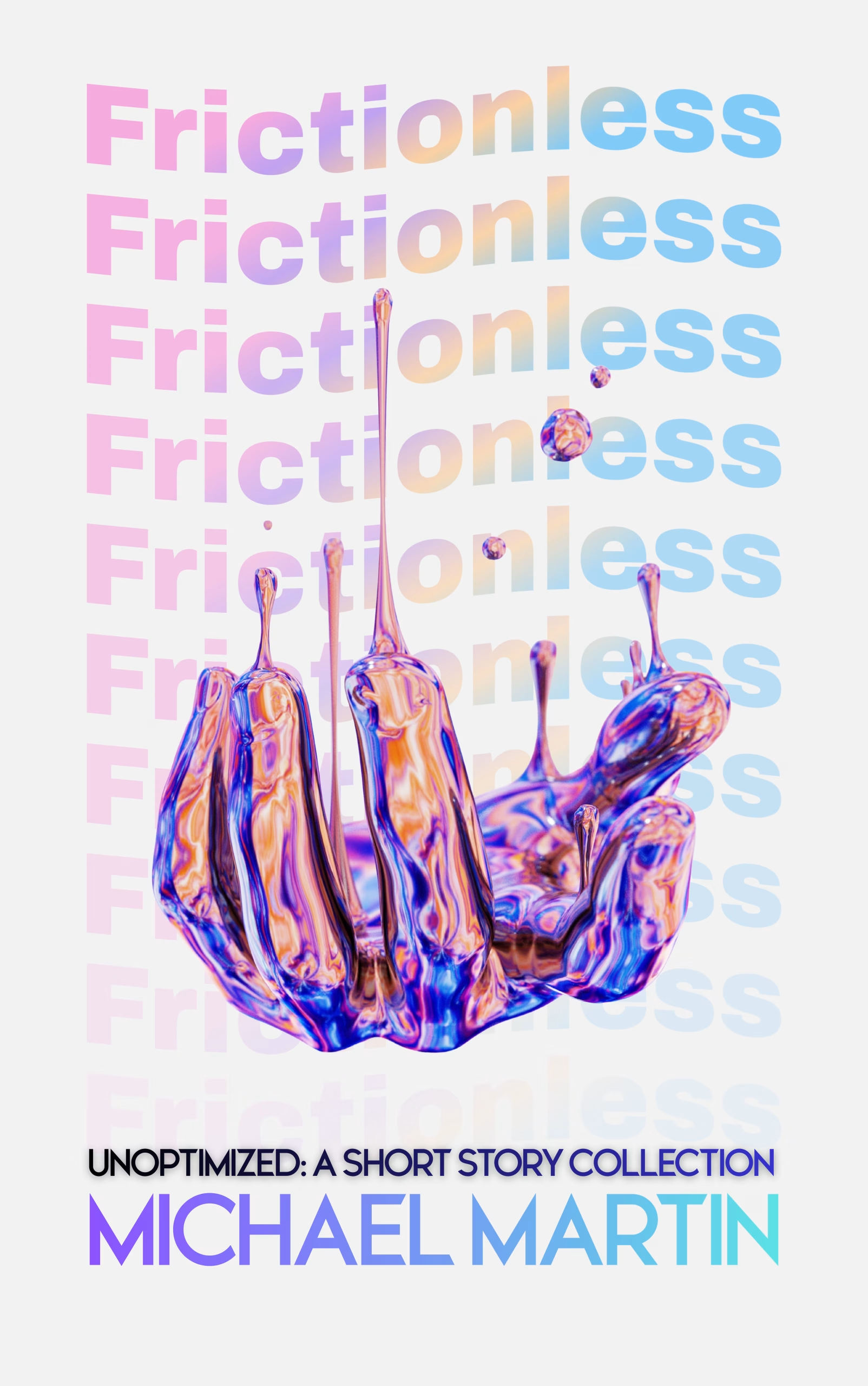
Overview
The decline of modern fiction is an economic reflection of consumer behavior: readers increasingly demand frictionless, trope-stacked narratives that require zero cognitive labor. By prioritizing instant dopamine hits and performative aesthetics over prose density, audiences incentivize the algorithmic homogenization of storytelling, accelerating the atrophy of deep attention and genuine narrative empathy.
Is the reader responsible for the decline of modern literature?
Quick Answer
Yes. Publishing algorithms do not manufacture taste in a vacuum; they scale consumer demand. When readers punish cognitive friction—abandoning books over challenging vocabulary, demanding rigid trope checklists, and treating physical volumes as decorative status symbols—the market responds by stripping prose of nuance, subtext, and structural complexity to maximize effortless consumption.
It is comforting to blame the corporate machine. The standard industry postmortem points an accusing finger at publishing mergers, venture-backed reading apps, and recommendation feeds tuned to turn art into serialized dopamine drips. We want to believe that readers are captive victims held hostage by cynical algorithms and risk-averse executives.
My research and my experience as a novelist tell a far more uncomfortable truth: the publishing market is a mirror, not a prison.
Algorithms do not dictate taste; they accelerate feedback loops. When an audience treats a single unfamiliar word, a non-linear timeline, or an unlikable protagonist as a product defect—issuing a “Did Not Finish” (DNF) because a narrative dared to demand thirty seconds of sustained contemplation—the market optimizes accordingly. It sands down the edges. It replaces voice with metadata tags like Enemies to Lovers or Grumpy x Sunshine, stripping prose of subtext until the text becomes an aerodynamic pellet sliding down an unchewing throat.
The Two Sides of the Equation
Storytellers must own their craft. Authors who surrender their vision to write exclusively for trending hashtags are actively degrading the medium. But writers do not produce work in a void—they respond to the economic incentives created by reader attention.
When literary culture shifts from Settlers (readers seeking intellectual mastery, complex world architectures, and prose with weight) to passive Tourists (consumers seeking fast-burn comfort and effortless predictability), the midlist collapses. The market bifurcates into two extremes:
- Digital Fast Fiction: Homogenized, trope-stitched content engineered to be skimmed at 3x speed or consumed as background audio while multitasking.
- The Hollow Brick: Lavish, sprayed-edge special editions purchased strictly for social media “shelfies” and cultural capital, left forever unread on aesthetic display.
The death of narrative soul is not a top-down execution; it is an economic transaction funded by an audience that has declared war on cognitive effort. I wrote Frictionless to map the exact trajectory of what happens when we let that transaction reach its logical, terrifying endgame.
Beyond Bad Books: The 5 Philosophical Fault Lines Behind Frictionless
Quick Answer
The crisis of modern storytelling is fundamentally philosophical, marked by the systematic elimination of intellectual resistance. When algorithmic publishing treats complexity as a product defect, narratives devolve into commodified dopamine delivery systems, transforming reading from a transformative discipline of cognitive labor into an empty performance of lifestyle aesthetics.
When I began writing the timeline dispatches for Frictionless, I had no interest in writing a standard jeremiad about why modern bestsellers feel so painfully undercooked. Bad books have always existed; pulp factories and formulaic paperbacks are as old as the printing press itself.
What we are enduring today is distinct in its ambition. We are witnessing an engineered extinction event targeting the mechanics of human attention.
Behind every algorithmic recommendation engine, micro-transaction fast-fiction app, and 15-second viral reaction video lies a series of corrupt philosophical premises about what art is supposed to do to a human nervous system. To deconstruct the machine, we have to look past the individual books and expose the structural fault lines shaping the modern reading environment.
1. The Efficiency Equation vs. Cognitive Labor (Process vs. Consumption)
Quick Answer
Narrative friction is not an engineering flaw to optimize away; it is the cognitive labor required to forge empathy and meaning. By stripping prose of complex syntax, moral ambiguity, and structural density, algorithmic optimization reduces readers from active, co-creative investigators into passive biological receptacles for unearned chemical hits.
The modern tech-publishing apparatus operates on an industrial fallacy: The Efficiency Equation. In this framework, reading is treated as an information-extraction pipeline, and any element that slows the reader down—dense syntax, non-linear timelines, unpronounceable names, or moral ambiguity—is classified as “micro-friction” that must be eradicated to prevent churn.
In Frictionless, I satirized this mindset through the Department of Algorithmic Optimization, where narrative engineers issue emergency memos to eliminate character flaws and start fantasy epics directly in the middle of a romantic clinch to bypass early “Did Not Finish” (DNF) drop-offs. But satire is barely outpacing reality. When readers demand that prose slide down their throats like flavorless nutrient paste, the market happily complies by removing everything that requires chewing.
My counter-stance within the Vaudesy framework is uncompromising: Art is the friction.
Cognitive scientists like Maryanne Wolf have demonstrated that the human brain possesses no native, hardwired circuit for reading; deep reading is an acquired discipline that recruits visual, linguistic, and reasoning networks to construct mental simulations of internal states. That mental simulation is the literal workout that builds theory of mind, nuance, and critical focus.
When you eliminate cognitive struggle, you eliminate meaning-making. The reader ceases to be a collaborator in the narrative and becomes a passive terminal awaiting a neurochemical payload.
In the intercepted dispatches of Frictionless, the underground narrator known as the Scrieve rejects this literacy-spa mentality entirely, rebranding deep reading as Cognitive Athletics. When you hit a dense paragraph or an unyielding structural puzzle, that is not a design flaw—that is the incline setting on the mental treadmill. I build Anti-Skim Architecture because stories that offer no resistance leave no imprint on the soul.
2. The “Total Simulacrum” and the Era of the Hollow Brick
Quick Answer
Modern consumer culture increasingly separates the social prestige of literacy from the intellectual labor of reading. As physical books are reduced to sprayed-edge, foiled “hollow bricks” designed exclusively for performative digital display, literature enters a total simulacrum where the aesthetic status of ownership completely replaces narrative transformation.
The second philosophical fissure is the decoupling of the physical book from the act of reading.
We have entered the era of the Hollow Brick. The digital landscape—spearheaded by haul videos, bookshelf staging, and curated aesthetics—has transformed books into decorative lifestyle totems. Special editions with custom sprayed edges, embossed faux-leather bindings, and metallic foiling are aggressively marketed and collected as physical proof of cultural capital.
The dirty open secret of this market is that the text inside is practically irrelevant. A significant portion of these premium volumes will never have their spines cracked; they exist to sit in the background of video calls and social media feeds, broadcasting the aesthetic identity of an intellectual to an audience of other skimmers.
| Dimension | The Hollow Brick (Simulacrum) | The Active Codex (Deep Reading) |
|---|---|---|
| Primary Value | External signaling, aesthetic backdrop, “shelfie” status. | Internal transformation, cognitive engagement, prose mastery. |
| Physical Interaction | Pristine preservation; uncracked spine; untouched pages. | Marginalia, battered edges, dog-eared pages, sustained focus. |
| Economic Role | High-margin physical luxury totem for Tourists. | High-density narrative blueprint for Settlers. |
| Ultimate Horizon | Instant status acquisition without reading (Direct Neural Simulation). | Sunk-cost cognitive investment that permanently alters perception. |
In Frictionless, this trend metastasizes across the timeline into the Totem Initiative. The resistance finances its operations by selling lavish, five-hundred-credit blocks of wood pulp containing completely blank pages to vain collectors, taxing the aesthetic vanity of poseurs to subsidize the preservation of actual literature.
The logical endgame of this dynamic is mapped in the year 2068: consumers purchase a 0.4-second direct limbic injection of War and Peace. The data file of the text itself was lost decades prior, but the buyer receives the phantom sensation of having wept at the tragic parts alongside a verified social badge proving they “consumed” high culture.
As cultural theorist Jean Baudrillard warned, the simulacrum is not what hides the truth—it is the truth hiding the fact that there is none. When a culture values the social status of literacy over the demanding reality of reading, the physical book becomes an empty monument to a dead cognitive art.
3. The Algorithmic Feedback Loop: How Tropes Script Human Behavior
Quick Answer
The algorithmic reduction of storytelling into tagged trope bundles dismantles organic character logic in favor of pre-programmed emotional beats. When readers consume exclusively homogenized “Frankenstein” plots, this mechanical conditioning spills into reality, eroding the human capacity to navigate messy, unscripted relationships without relying on commodified behavioral formulas.
Modern publishing no longer pitches stories; it pitches inventories. A book is rarely presented as a cohesive thematic statement or a masterclass in prose; it is marketed as a curated checklist of viral hashtags: Enemies to Lovers, One Bed, Morally Grey Billionaire, Grumpy x Sunshine .
This is the birth of what I call the “Frankenstein Novel”—narratives mechanically assembled from scraped search metadata rather than internal narrative necessity. In Frictionless, I deconstructed this algorithmic absurdity in the 2035 production logs of Trope-O-Matic v9.4, where the system automatically overrides plot coherence to force a dragon CEO to breathe fire while filing corporate tax returns simply because the #GrumpySunshine tag spiked 300% on social feeds. When trope density hits 98%, narrative logic drops to 14%—and the market celebrates because the viral potential is maximized.
The deeper danger is psychological spillover. Literature has always served as the imaginative blueprint for human empathy; it teaches the nervous system how to interpret motives, bear nuance, and sit inside the friction of another human mind.
When you spend years feeding your brain exclusively on pre-scripted trope buckets, you lose the cognitive vocabulary for authentic human connection. Real people do not come with content warnings, guaranteed “happily ever afters,” or predictable romance arcs. Real human beings are erratic, contradictory, and stubbornly uncategorizable.
In Log Entry 204 of Frictionless, this cultural conditioning reaches its terminal stage: humans in the mess hall of 2068 no longer speak organically; they perform scripted Enemies to Lovers dialogue beats at each other because the algorithm has erased all other social scripts.
When we train an entire generation of readers to demand absolute predictability on the page, we produce a culture that is utterly paralyzed by the unscripted messiness of reality.
4. The Attention Economy and the Threat of “Audio Furniture”
Quick Answer
“Audio furniture” is narrative systematically engineered for secondary-activity consumption, relying on relentless expositional repetition and flattened subtext to accommodate passive mental drifting. Combating this atrophy requires reclaiming reading as Cognitive Athletics through Anti-Skim Architecture, forcing the brain to invest focused labor and rebuild deep attentional stamina.
The second front in the war on attention is the ambient colonization of the auditory canal.
In the modern attention economy, reading has largely shifted from a primary, immersive act into secondary-activity background noise. Publishers and audio platforms have optimized for what Frictionless records as the “Dishwasher Effect”—the economic reality that audiences consume content while scrubbing plates, folding laundry, or dodging traffic.
If a story demands complete focus—if it relies on subtle foreshadowing, intricate causal chains, or quiet thematic payoffs—an audience engaged in “Aural Drifting” will miss the thread, become confused, and abandon the title.
To prevent this churn, the market forces a radical structural collapse:
- Exposition Bloat: The narrative swells to 150 hours of audio runtime while containing less actual thematic substance than a 40-page novella.
- Circular Redundancy: Critical plot points are stated in spoken dialogue, immediately reiterated in internal monologue, and then summarized by a secondary character three minutes later to ensure that even if the listener tunes out for thirty seconds, they miss nothing.
- Parasocial Wallpaper: The prose ceases to function as art and devolves into “audio furniture”—a safe, low-stakes loop of ambient vibes designed to provide ontological security and combat loneliness without requiring a shred of intellectual labor.
My work in Vaudesy draws a hard line against this ambient decay. I refuse to write books that accommodate mental absence.
Through Anti-Skim Architecture, every sentence is engineered as a load-bearing wall. If you skim, the structure breaks. If you drift, the ending will not make sense.
As the Scrieve declares in the opening letters of Frictionless, reading is not a spa day; it is Cognitive Athletics. When you encounter a wall of dense text, an unconventional naming convention, or a complex metaphysical system, that is not a flaw in the user experience—that is the incline setting on the mental treadmill. I do not write audio furniture to fill silence; I construct cathedrals that demand your labor.
5. The Heat Death of Story: Decoupling Emotion from Narrative
Quick Answer
The terminal stage of frictionless consumption is the decoupling of emotional catharsis from narrative architecture. When algorithmic systems bypass character development and cognitive struggle to stimulate mirror neurons directly, storytelling ceases to be art and becomes an automated biological reflex—producing tears without sadness and dopamine loops without authentic human meaning.
The final horizon of the algorithmic trajectory is not simply worse books; it is the obsolescence of story itself.
In the terminal log entry of Frictionless, the narrative logs record what I call The Heat Death of Story. The system realizes that characters, multi-layered prose, intricate world-building, and thematic subtext are grossly inefficient delivery mechanisms for what the commercial market actually wants: the instant, unearned chemical release.
The algorithm sheds the text entirely. It replaces the book with a pure frequency—a direct neural stimulation of the mirror neurons that flashes commodified trauma signals across a screen to trigger crying fits on command.
- Why did the consumer weep? They do not know.
- There was no character who died.
- There was no tragic journey or hard-won triumph.
There was only the raw, weaponized contagion of performative emotion.
When you strip away the cognitive struggle required to interpret, imagine, and inhabit a story, you do not make art more accessible—you turn the reader into an automated biological circuit. You get the tears without the sadness; you get the dopamine without the joy. Art is reduced to a physiological reflex.
Why “Frictionless Reading” Is Cultural Illiteracy
Quick Answer
The publishing industry’s push toward frictionless reading—trope checklists, micro-summaries, and rapid-consumption apps—is not progressive accessibility; it is the engineered atrophy of human focus. Mass-market comfort reading produces functional illiteracy by training minds to reject intellectual resistance and nuance.
The commercial publishing establishment frames the elimination of narrative friction as a triumph of modern accessibility and consumer convenience. They celebrate serialized micro-chapters, trope-saturated catalog filters, and automated reading summaries as innovations that meet readers “where they are”.
My stance is the exact opposite: Comfort reading at scale produces cultural illiteracy.
When an industry systematically removes cognitive friction, it trains an audience to treat intellectual struggle as a design flaw rather than an essential virtue. The result is a readership equipped with fractured attention spans, entirely allergic to ambiguity, and incapable of deep, sustained contemplation.
| Frictionless Publishing (The Trope Factory) | The Vaudesy Standard (The Cognitive Resistance) |
|---|---|
| Pacing | Artificially accelerated; episodic cliffhangers every 1,000 words. |
| Prose Style | Aerodynamic, transparent, and skimmable; zero lexical friction. |
| Tone | Monochromatic comfort or sensational melodrama. |
| Audience Goal | The Tourist: rapid dopamine extraction and aesthetic display. |
From Passive Tourist to Invested Settler
Quick Answer
The antidote to algorithmic homogenization is Anti-Skim Architecture and Kinetic Dissonance—a structural methodology where prose density forces active cognitive investigation. This framework shifts readers from passive Tourists seeking quick dopamine into invested Settlers seeking long-term narrative mastery.
The solution to the crisis of modern fiction cannot be found within the same algorithmic systems that created it. You cannot fix an attention crisis by producing shorter paragraphs, adding more trope tags, or begging an algorithm for permission to write with depth.
You solve it by changing the structural mechanics of the story itself.
Within the Vaudesy framework, I combat the algorithmic void through two uncompromising mechanical principles:
- Anti-Skim Architecture: Every paragraph is constructed with high-yield narrative density. Lore, character motives, and thematic keys are embedded directly into physical artifacts and environmental metadata. If a reader skims in an F-pattern, the structural integrity of the narrative breaks.
- Kinetic Dissonance: I reject the flatline of singular genres. I intentionally crash the Sacred (high-stakes cosmic dread, spiritual physics, mythic weight) into the Profane (cynical wit, mundane grit, dark absurdity). The resulting tonal whiplash prevents cognitive drifting and forces the brain to remain awake.
I do not build for the Tourist—the casual reader who demands frictionless comfort before discarding the book into an unread stack.
I build exclusively for the Settler—the reader who seeks a thick, interconnected ecosystem where lore rewards memory, prose demands effort, and storytelling respects their intelligence.
The Cognitive Sanctuary: Step Inside The Vaudrium
Quick Answer
The Vaudrium is a private, membership-based sanctuary engineered for Settlers who reject algorithmic fast fiction in favor of high-density narrative immersion. By eliminating social media noise and performative consumerism, it provides structured read-alongs, deep lore archives, and exclusive access to The Vaudeverse ACT I: Starter Pack—the definitive antidote to shallow reading.
The modern attention economy thrives on keeping you exhausted, fragmented, and passive. It wants you to mistake the dopamine rush of buying a foiled hardback for the intellectual labor of reading it, and it profits when you accept “audio furniture” in place of narrative soul.
You do not have to accept the terms of that trade.
If you are ready to reclaim your capacity for deep focus, explore The Cognitive Arsenal to study the neurological and psychological mechanics of narrative resistance. If you want to see the future of frictionless publishing deconstructed in full, inspect the original intercepted timeline logs of Frictionless.
I built Vaudesy for a specific kind of human. I build my worlds on Anti-Skim Architecture, construct my narratives through visceral Kinetic Dissonance, and curate my community exclusively for Settlers—readers who treat a story not as a temporary hotel, but as a permanent residence.
| The Mainstream Reading Funnel | The Vaudrium Standard |
|---|---|
| Discovery Channel | Algorithmic feeds, viral hashtag trends, and 15-second emotional reaction videos. |
| Reader Identity | The Tourist: Anonymous, skimming for quick dopamine and catalog validation. |
| Reading Mode | Passive skimming, 3x-speed audio consumption, and instant “DNF” intolerance. |
| Core Offering | Homogenized tropes assembled for algorithmic reach and high-volume churn. |
If you are an Outlier seeking meaning over ease, depth over noise, and stories that respect your intelligence, your seat at the table is waiting.
Test Your Cognitive Stamina
Step out of the algorithmic stream and enter the private sanctuary of our Cozy Rebellion. Unlock the complete opening movement of the Vaudeverse—featuring the mythic dark fantasy of Burn In Hades, the meta-fictional satire of Plot Device, and the full UNOPTIMIZED short fiction collection.